<?xml version="1.0" encoding="utf-8"?>
<feed xmlns="http://www.w3.org/2005/Atom" xmlns:media="http://search.yahoo.com/mrss/">
    <title>Tom Kenis</title>
    <link href="https://tomkenis.com/feed.xml" rel="self" />
    <link href="https://tomkenis.com" />
    <updated>2026-09-05T14:35:11+02:00</updated>
    <author>
        <name>Tom Kenis</name>
    </author>
    <id>https://tomkenis.com</id>

    <entry>
        <title>Everyone has artillery now</title>
        <author>
            <name>Tom Kenis</name>
        </author>
        <link href="https://tomkenis.com/stories/everyone-has-artillery-now/index.html"/>
        <id>https://tomkenis.com/stories/everyone-has-artillery-now/index.html</id>
        <media:content url="https://tomkenis.com/media/posts/129/Screenshot-2026-09-05-at-14.28.17.png" medium="image" />

        <updated>2026-09-05T14:33:21+02:00</updated>
            <summary type="html">
                <![CDATA[
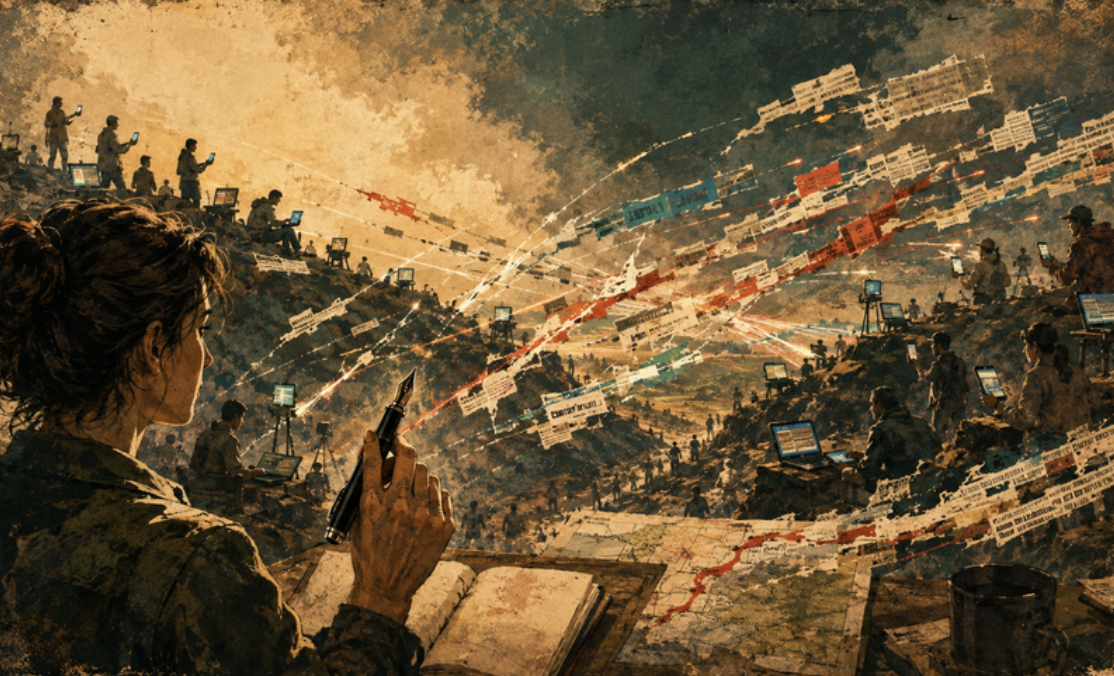
                        <img src="https://tomkenis.com/media/posts/129/Screenshot-2026-09-05-at-14.28.17.png" alt="Illustration of a person holding a smartphone as streams of messages cross a crowded landscape." />
                    Information integrity in the age of AI With conflicts in West Asia, Ukraine, Sudan, and elsewhere showing no signs of abating, media focus, rightly, on the kinetic exchanges and their immediate victims. Who is firing what in whose general direction? What damage&hellip;
                ]]>
            </summary>
        <content type="html">
            <![CDATA[
                    <p><img src="https://tomkenis.com/media/posts/129/Screenshot-2026-09-05-at-14.28.17.png" class="type:primaryImage" alt="Illustration of a person holding a smartphone as streams of messages cross a crowded landscape." /></p>
                <h2><strong>Information integrity in the age of AI </strong></h2>
<p><em>With conflicts in West Asia, Ukraine, Sudan, and elsewhere showing no signs of abating, media focus, rightly, on the kinetic exchanges and their immediate victims. Who is firing what in whose general direction? What damage is caused to military assets, to civilian infrastructure, and to the civilians themselves? Truth, in the fog of war, is always the first casualty. Doubly so in the age of social media and AI. On the information battlefield, smaller belligerents are starting to have equal firing power.</em></p>
<p>Military technology has undergone a step change in recent years. Drones are all the rage, literally. From large loitering observational platforms to cheap consumer-grade FPV drones. Tiny quadcopters offer the operator a first-person view and the eerie ability to follow their unfortunate targets hiding behind walls, inside buildings, or briefly emerging from an armoured personnel carrier. Historically, technological leaps have tended to shift the military advantage from the defender to the attacker or vice versa. The jury is still out where drones fall on this spectrum. What’s already abundantly clear: you don’t want to be the one who doesn’t have them.</p>
<p>The weapons for fighting information wars have made similar leaps. On its own, social media represented a radical shift. Its global reach and low cost made it much easier for smaller states, non-state actors, or even individuals to produce and spread propaganda (or ‘disinformation’ if it’s your enemy doing it). One can view this as a clear negative, like unfettered access to nuclear or biological weapons. On the flipside, impecunious Robin Hoods are now at liberty to pierce hitherto unassailable ideological bulwarks of unjust dominant powers.</p>
<p>Journalism itself has fragmented. This too is neither as dramatic, nor necessarily as bad, as it sounds. Sure, large Western media conglomerates have been more permitting of dissenting views than, say, the Central Publicity Department of the Chinese Communist Party, but they clearly have biases. In global information markets, these biases are more exposed than ever. And with exposure comes the potential for reform. Put differently, the waning reach of CNN or the BBC, Rupert Murdoch or Axel Springer-owned propaganda factories is filled by nimbler investigative outlets like The Intercept, Zeteo, Drop Site News, Mediapart, Correctiv, Forensic Architecture, which owe their reach to social media.</p>
<p>Okay, back to our military technology metaphor. The cannon rendered medieval city walls obsolete. Aircraft carriers outclassed battleships with superior reach. And where social media had started picking away at centralized information distribution, AI has put this process on steroids. Anyone with a free ChatGPT account and an axe to grind can broadcast. It’s a bad time for gatekeepers.</p>
<h2 id="the-empires-strike-back">The empires strike back</h2>
<p>Western authorities have not been able to reverse the fundamental power shift. The US threatened to ban, then forced the sale of China-based TikTok for spreading information deemed insufficiently aligned with Western interests. Age requirements for social media are now in place in Australia. Other countries are considering similar moves. Platforms and users adapt around rules, and the overall information environment remains far more contested and less hierarchical than that of the pre-social-media era.</p>
<p>Authoritarian regimes seem to have achieved tighter domestic containment. China continues to suppress most open dissent, shaping the information environment with high effectiveness, while Russia has largely shut out major Western platforms, and mandates registration of bloggers with more than 10k followers. But for how long? Local Chinese AI models already enable citizens to “vibecode” censorship-skirting tools, albeit at a limited scale. Next-generation tools running on ever cheaper hardware can be expected to lower the skill threshold further.</p>
<h2 id="zooming-out">Zooming out</h2>
<p>AI’s potential doesn’t seem to stop at ‘merely’ renegotiating human power relations. The same forces that have equalized information firepower are beginning to put pressure on slower, institutionalized knowledge systems: the scientific and philosophical frameworks that have long organized our understanding of the world. Inside societies, democratic or otherwise, the establishment of common knowledge frameworks has historically been a glacial process. Consensus views are established over years, decades, and indeed centuries. The longer any paradigm holds, the more difficult it becomes to dislodge it, however erroneous. Ask Galileo Galilei.</p>
<p>A looser, faster exchange of ideas is not necessarily a bad thing, but challenges abound. Mathematicians using AI are solving one age-old maths problem after another. Over time this is likely to revolutionize our very understanding of the cosmos, particularly in those domains where the bottlenecks have mainly been mathematical rather than purely observational. What happens at the boundary of a black hole? What, if anything, preceded the Big Bang? These are not isolated curiosities; the same AI-driven acceleration is beginning to affect other long-standing bottlenecks — mathematical, conceptual, and engineering — that shape how we understand both mind and matter. Follow me a little deeper into the rabbit hole.</p>
<h2 id="thinking-about-thinking">Thinking about thinking</h2>
<p>Current materialist theorists see consciousness as a deterministic process, with the ‘self’ arising out of sufficiently complex arrangements of molecules. If this is indeed the case, a warehouse stacked to the roof with Nvidia chips should produce the same end result as a wet brain, i.e. consciousness. Some wonder whether our frontal lobes should more accurately be seen not as a transmitter of thoughts, but as a radio receiver, filtering specific frequencies of an all-enveloping higher-dimensional universal consciousness field. This used to be fodder for philosophers, but one of the results of the arms race to build ever bigger models is set to take the first option off the table for good.</p>
<p>In the realm of more practical pursuits, like the number of lightbulbs humans can screw in without destroying the habitats of monkeys and all the rest, we are already seeing timelines for commercial-scale nuclear fusion energy — the stuff that runs the sun — being compressed by AI-powered maths. AI will destroy us? Perhaps it will save us first.</p>
<h2 id="language">Language</h2>
<p>With power structures and even the foundational frameworks of knowledge shifting underneath us, what remains? What can we be sure of anymore in this fluid age? Short of reverting to a Descartes-inspired hard philosophical reset, a sensible, albeit makeshift, answer would be to focus on the glue that has held together the human family since the beginning of language itself: stories. At the most basic level, what has anchored groups of people is language itself, from when we could barely rub two sticks together all the way down to the age of self-driving cars. Without communication, no fire, no spears, no Zoom calls, no survival. A bit of a stretch, the Zoom calls, but you get the gist.</p>
<p>But however smart, technology will never tell us where to go. No device can connect past, present, and future quite like the retold overcoming of obstacles on our way to the next watering hole. Stories provide meaning. They connect disparate moments that exist in a static three-dimensional cube into a four-dimensional connected string with an arrow in the shape of the word ‘Why?’. Humans have often, prosaically, wondered what sets us apart from animals. Perhaps it’s the same thing that distinguishes us from intelligent machines, namely the ability to formulate purpose and direction. And to attack each other by undermining the other group’s ability to do so.</p>
<h2 id="information-integrity">Information integrity</h2>
<p>As battlefields go, the defence of reliable information with which individuals and societies articulate goals and steer decision-making can hardly be overestimated. Empirically speaking, facts are relatively easy to prove or disprove. But motivation, direction, meaning, or the lack thereof, are harder to salvage when under attack. Foreign Information Manipulation and Interference (FIMI) by malevolent actors is not only used to spread one side’s version of events. Increasingly sophisticated technological means, including AI, are directed at societies’ ability to process information, or even to exist as a group. Propaganda is not a new thing, but the speed, scale, and low cost of advanced forms of cognitive warfare are.</p>
<h2 id="not-all-heroes-wear-caps">Not all heroes wear CAPS</h2>
<p>And so, arguably, guarding the thin red line between chaos and civilization are a quiet bunch. More or less the opposite of the hard-nosed colonel portrayed by Jack Nicholson in A Few Good Men, famously blurting: “You can’t handle the truth.” Communication professionals beaver away discreetly, strictly lower case. In defence of truth, connecting decision-makers with everyone else. From the tiniest NGO, to countries, supranational associations, and humankind itself, answering the ‘Why?’ question is the hardest and also the most crucial. Without it, empires flounder, continuously winning battles but losing the plot.</p>
<p>Soon, anyone with a Claude account will be able to produce a two-minute explainer video. Good. The tooling was never the interesting part. What a model cannot do is decide what the video is for: which single idea, out of forty competing ones, survives the edit; what the audience already believes and where that belief will resist; what tone earns a donor’s trust and which faux pas loses a field office. Techniques get cheaper; direction gets scarcer. The further the craft floor drops, the more the challenge migrates upward, to the person conceiving the brief and answering for the choices in it: the comms strategist. We can allow the STEM field that produced this technical marvel its well-deserved victory lap. But perhaps it's time for us lowly humanities folks to come galloping back onto the battlefield and brandish our… pen. Which, as it turns out, truly always was mightier than the sword.</p>
<p><i><u>Author’s note</u>: The text is fully human-written. AI helped map the research, stress-test the argument and proofread spelling and grammar. The analysis, voice and final wording are mine, as is responsibility for any errors.</i></p>
<p><em>First published on makeshiftpublishing.com on 27 August 2026</em></p>
            ]]>
        </content>
    </entry>
    <entry>
        <title>Failed states: a tale of two walls</title>
        <author>
            <name>Tom Kenis</name>
        </author>
        <link href="https://tomkenis.com/stories/failed-states-a-tale-of-two-walls/index.html"/>
        <id>https://tomkenis.com/stories/failed-states-a-tale-of-two-walls/index.html</id>

        <updated>2026-07-06T12:00:00+02:00</updated>
            <summary type="html">
                <![CDATA[
                    The ethnonational state, particularly when organised around ancestry, historical trauma and permanent insecurity, doesn’t cure collective vulnerability. It tends to institutionalise it, giving fear, grievance and supremacy a bureaucracy and an army. Germany and Israel are not ‘failed states’ in the conventional&hellip;
                ]]>
            </summary>
        <content type="html">
            <![CDATA[
                <p>The ethnonational state, particularly when organised around ancestry, historical trauma and permanent insecurity, doesn’t cure collective vulnerability. It tends to institutionalise it, giving fear, grievance and supremacy a bureaucracy and an army. Germany and Israel are not ‘failed states’ in the conventional sense: both built formidable institutions and proved exceptionally capable of projecting power. Rather, they reveal how readily the nation-state condition itself is prone to failure, mistaking a people’s legitimate desire for security and collective life for an unrestricted right to possess the state, define its population and dominate and murder those who fall outside the national story.</p>
<p>The grand halls of Versailles are famous for many things. Their golden splendour, for one. Students of history will point to the punitive treaty of surrender imposed on Germany after World War I. As to the boisterous delusion that led Donald Trump to choose the location to sign the memorandum of ‘understanding’ after the disastrous US-Israeli war against Iran — conceding to all of the latter’s demands — one can only marvel. But scratch, and the warren of failure goes a level deeper.</p>
<p>France didn’t choose Versailles to humiliate — and essentially end — the German empire by accident. For it was the Germans who in 1871 marched into its mirrored corridors to proclaim victory over their Gallic arch-nemesis, and their own late arrival into the family of European nation states. German historians of the Romantic era consciously framed this genesis in the trauma of the Thirty Years’ War of 1618–1648 — not so much a rabbit hole as an archaeological dig.</p>
<p>The image they saw reflected back at them in Versailles was that of ‘victims’: first of scheming and warring Europeans who cost them a third of their population (a politically motivated exaggeration, later historians assert), and after 1918, of Jews and Bolsheviks — used more or less interchangeably at the time. The new German state rested on the so-called ius sanguinis, or ‘blood right’, linking people to the land by familial — later reinterpreted as genetic — lineage, rather than treating nationality as something that can be joined or earned ‘simply’ by choosing to live in a place and adapting to its mores. France presents itself in the latter light, as does the United States (recent attempts to subvert its founding philosophy notwithstanding). Germany’s history matters here not because Germans are uniquely dangerous, but because it reveals what can happen when collective insecurity acquires borders, institutions and sovereign force.</p>
<h2>Victim’s Victim’s Victim</h2>
<p>In 1948, fresh from another World War, German ‘victimhood’ spawned yet another European nation state with blood-based membership rules: Israel. This state is in many ways Germany’s mirror image, their geneses more intertwined than a ‘mere’ Holocaust would suggest. The Zionist movement predates Nazism, rooted as it was in Europe’s antisemitic core; but once it got underway in practical terms, it needed anti-Jewish policies to push enough Jews out of Europe and into the Holy Land to make the new state viable. As inelegant as it may sound, up to a point, Nazism’s and Zionism’s interests coincided. Israel’s Law of Return, moreover, resembles Hitler’s Nuremberg system in its bureaucratic reliance on Jewish genealogy, though it functions less as a mirror than as a partial inverse: descent that once triggered exclusion can now trigger privileged admission.</p>
<p>Germany has since come to terms with its past — or so they would have themselves believe. Nazi perpetrators were rounded up and put away, reparations paid, and a culture of remembrance and contrition — Erinnerungskultur — instated. In practical terms, this meant that the Jewish-Israeli state received the German state’s wholehearted support to build out its homeland: not in Saxony-Anhalt, Bavaria, or North Rhine-Westphalia, but in Palestine. In other words, Germany’s victims were free to victimise anyone of their choosing. Germany’s original sin, then, was exported much in the way old cars or mountains of discarded garments are dumped across the developing world.</p>
<h2>Staatsräson</h2>
<p>In today’s Germany, questioning unconditional diplomatic support for Israel’s brutal occupation of Palestinian land, dispossession and daily murder, or the seemingly limitless arms sales that sustain it, is treated as something close to treason. Germans of Palestinian descent are the primary target of this policy, but German Jews are far from immune. For example, Jüdische Stimme für gerechten Frieden in Nahost, a Berlin-based Jewish anti-Zionist association, has on multiple occasions had its bank accounts frozen. Their bank demanded, among other things, a list of the association’s members before it would restore access. One hundred and fifty-five years after its founding, Germany has failed at the essential task it set itself after World War II: to reckon with its atrocious past. As a consequence, the country that once led Europe in philosophy and science stands politically and culturally diminished. A failure of historic proportions.</p>
<p>While the destruction of the Herero and Nama peoples reflected its white supremacism, German antisemitism — like the entire German national project — was steeped in an inferiority complex. German Jews, among Europe’s most integrated — doctors, lawyers, philosophers, scientists — were seen as competitors. Not as what they actually were: an integral component of Germany’s pre-World War I stature as Europe’s most advanced nation.</p>
<p>Racism born of perceived inferiority — ‘status-anxious majoritarianism’ — is not exclusive to Germany and its Jews. Comparable dynamics appeared in the Russian pogroms against its Jews, and in Ottoman persecution of Armenians and Greeks. In Nigeria, Igbo success in education, administration, and commerce fed fantasies of Igbo domination that contributed to the pogroms of 1966. The Rwandan genocide drew on similar dynamics, with Hutu extremists presenting mass violence as a popular “rising up” against supposedly privileged Tutsis. The minority was stereotyped simultaneously as unusually capable, clannish, exploitative and disloyal. Adding insult to Teutonic injury, it was first German and later Belgian colonial rule that hardened more fluid social distinctions in Rwanda and Burundi into ethnic categories of rulers and ruled, the better to govern both societies from above.</p>
<h2>Circumstance, Not Chromosomes</h2>
<p>What Zionism has wrought in Palestine is by now well known and disputed by few. It has led to yet another genocide: Israel’s first and, by complicity, Germany’s third. The failure of Germany’s national project has much in common with Israel’s. The demise of both — from admired scions of European Enlightenment to something altogether much reduced — is linked to their physical separation.</p>
<p>It would be difficult to attribute Germany’s former ‘greatness’ primarily to its pre-1933 Jewish minority, and more difficult still to suggest that one group was simply ‘smarter’ than another. In an age still strongly shaped by genetic explanations of human difference, such claims are analytically hazardous and can all too easily reproduce the racial thinking they seek to reject, notwithstanding the disproportionately high per capita share of PhDs and Nobel laureates among Jews, a point repeatedly raised with me by a Jewish friend.</p>
<p>This author roundly rejects the reigning paradigm that places nature far above nurture. Where once respectable scientists explained human destiny, from intelligence to a propensity for violence, through the size and shape of people’s skulls, today all ills and virtues seem to pass through a genetic lens. I am convinced we will look back on this era with wry derision. The heights of astronomy and law achieved under the Abbasid caliph Harun al-Rashid in the early ninth century are not hardwired into Arabs. The rise of British industry does not sit in the ‘English DNA’. Nor does its demise into the pathetic shambles that is post-Brexit Britain. It is circumstance, I believe — opportunities seized upon or foregone, plus a handy dose of purest chance — that makes or breaks people and nations alike.</p>
<h2>Portable homeland</h2>
<p>The circumstances that, across three thousand years of beautiful tradition, from Moses to Sandy Koufax, helped foster Jewish intellectual and cultural achievement often arose from proximity to, at the same time partial separation from, larger societies. This has always been a precarious position to be in: relegated to the socio-economic margins, subjected to repeated pogroms in Tsarist Russia, taxed as a ‘protected’ minority alongside Christians under Muslim caliphates and the Ottoman Empire, and violently expelled from Reconquista Spain. This sense of interdependence without quite belonging, combined with religious traditions of textual study, urban life, multilingualism, trading networks, and exclusion from land or guilds, encouraged investment in portable forms of capital: learning, professional skills, communal networks, and a lattice of tradition, science, and religious scholarship. It also fostered an outward vigilance, a habit of watching for dangers, of which there were many. None of this was universal, nor did persecution itself ‘produce’ Jewish intellectual prowess. Rather, particular institutions and historical constraints repeatedly rewarded knowledge that could survive displacement.</p>
<h2>Fish out of Water</h2>
<p>All this did not come to an end in 1948, but it acquired a powerful counter-current. The roughly 750,000 Jews then in Palestine, some 7% of the world’s 11 million, became citizens of a sovereign state built explicitly as Jewish refuge and homeland. Today, 45% of the world’s 16 million Jews live in ‘the Jewish state’. This discussion does not concern who among Israel’s Jewish citizens are Zionist or anti-Zionist, nor the growing disenchantment, indeed anti-Zionism, among diaspora Jews. It concerns the different habits rewarded by different historical conditions. Minority existence often rewarded literacy, mobility, multilingual exchange, communal networks and the ability to read the surrounding society. Israel’s dominant institutions increasingly reward territorial possession, military conformity, demographic anxiety and siege thinking. These are not properties of ‘Jews’ or ‘Jewish thought’, but incentives created by a state that has made ethnonational supremacy its organising principle.</p>
<p>The transition from precarious minority to armed sovereign majority has pushed Israel’s dominant political culture towards a moral breaking point. To some, Israel is a launching pad for American militarism in a resource-rich region. To an increasing proportion of Americans, it is bogging the United States down in adventurous and costly policies diametrically opposed to its own interests. There are arguments to be had for both positions; though a certain wing of Trump voters likes to cast their hero and nation in the role of victim to scheming and evil Jews. Which, as strong as AIPAC and other pro-Israel lobby groups may be in Washington, is tantamount to denying the world’s most powerful nation any agency of its own. As if the US needed much additional persuasion to let its post-Cold War absolute power go to its head.</p>
<h2>Between the river and the law</h2>
<p>Within Israel’s dominant institutions, something has nevertheless been lost: not Jewish intelligence or moral capacity, neither of which was ever a biological inheritance, but some of the intellectual and ethical friction created by proximity, exchange and the need to see oneself through another’s eyes. National enclosure has encouraged an intellectual laziness: criticism can be dismissed as antisemitism, violence as self-defence and every Palestinian claim as proof of an eternal siege. Israel is a failed state as much as it is a state of failure, not because its institutions have collapsed — not yet — but because they work efficiently towards a morally bankrupt purpose.</p>
<p>Consider the mono-state that already exists in all but name. Between the river and the sea, a single power — the Israeli army — controls all of historical Palestine, with Palestinian rights apportioned in carefully calibrated, divide-and-conquer gradations: nominal voting rights inside official Israel; revocable residency in East Jerusalem; military law in the West Bank; and in Gaza, the right to be shot on sight — man, woman, or child. Beyond even these lines, it occupies swaths of Lebanon and Syria. Its prime minister, among other government officials, is a wanted man — indicted for war crimes and crimes against humanity while a genocide case grinds on in The Hague. The country has become a pariah on the world stage, not least among a growing number of Jews abroad.</p>
<h2>A small part of a larger whole</h2>
<p>After the Second World War, there were Allied schemes to keep Germany permanently weak. The American Morgenthau Plan envisaged deindustrialisation and a largely pastoral economy, while the Soviet Union dismantled factories and extracted reparations and labour from its occupation zone, helping to entrench Germany’s division. Western Europe’s leaders went the other way: instead of breaking Germany up into smaller parts, they endeavoured to make it a small part of a larger whole, defanging its dangerous inclinations through coal, steel, and ever-closer union.</p>
<p>This worked, up to a point. The neo-Nazi Alternative Für Deutschland now leads several national polls and stands poised to become the largest political party in several Länder. It is preparing for regional power and dreams openly of federal office. Whether it can breach the remaining political firewall is uncertain. So too is whether the old German reflexes were reformed or merely contained by prosperity, American protection and European institutions.</p>
<h2>The Impossible Arithmetic</h2>
<p>Germany’s godchild Israel meanwhile looks much weaker, despite standing at its territorial zenith and despite ministers dreaming openly of annexation and conquering Lebensraum from the Nile to the Euphrates. It has committed horrendous genocide in Gaza, still ongoing, yet Jews constitute only about half the population whose lives the state now controls between the river and the sea. Sooner or later, Israel must grant the non-Jewish half a say in how they are governed, meaning an equal vote and the end of Jewish political supremacy, or relinquish the non-Jewish territories it rules.</p>
<p>Traditionally, that ‘two-state solution’ meant withdrawing from the West Bank, East Jerusalem and Gaza. But the West Bank and East Jerusalem have been so thoroughly fragmented by Jewish settlements, settler roads, military zones and the so-called separation barrier that a viable Palestinian state is increasingly difficult to imagine without unimaginable mass evacuation of settlements or land swaps on an unprecedented scale. Israel therefore faces an arithmetic that no quantity of hasbara can resolve: share the state equally, or retreat from land it cannot govern democratically. Permanent occupation equals apartheid without end, and no system built on racist inequality lasts for ever.</p>
<h2>No country for old notions</h2>
<p>I, for one, remain optimistic. Not that the status quo will solidify or be ‘pacified’, but that a critical mass will be reached. The wall of shame, like the one that divided Berlin and the two Germanys, and which bites deep into and steals much of the Palestinian West Bank, will come down in our lifetime. Few expected the Berlin Wall to fall when it did. Until it did. All that took was a senescent politician bungling an interview question on live television.</p>
<p>When this wall comes down, I do not believe a democratic settlement need entail sending the Jews packing, seventy years of hasbara notwithstanding. Some Palestinians undoubtedly do; some Jewish Israelis will leave rather than live as equals, just as some white South Africans departed after the fall of the despicable apartheid regime. But revenge is not destiny. The more difficult task will be restitution, constitutional safeguards, shared institutions and the slow replacement of impunity with citizenship.</p>
<h2>Near, not apart</h2>
<p>Jewish life has often been at its richest in exchange with non-Jewish societies, not sealed off from them. North African countries from Morocco to Egypt, and the rest of the Middle East, became poorer places after their Jewish communities left or were driven out by a combination of nationalist excesses and Mossad false flag attacks. The same is true of Europe. A return of some Jewish communities to Arab countries is imaginable, and would be a splendid reversal of history, though it would require security, political change and invitation rather than nostalgia alone. Conversely, it is hardly difficult to understand why many Jews would feel no desire to return to Europe, a continent whose promises of belonging have so often proved conditional. Would you?</p>
<p>The classical nation state is perhaps not obsolete. Economically and technologically porous, it remains emotionally ferocious: people still want a political home, a story about who ‘we’ are and some control over collective life. Prosperity, globalisation and European integration did not dissolve those desires. They merely made nationalism briefly unfashionable. Nor is multinational government automatically humane. The decisive question is whether power is divided or absolute, citizenship open or hereditary, and rights protected from revocation by a majority. A nation may be entitled to cultural expression. It is not entitled to unrestricted possession of the state. Germany and Israel thus appear not as uniquely wicked among many others with blood on their hands, but as two stages in an experiment: one constrained through shared sovereignty and larger institutions, the other indulged in the belief that collective trauma confers a right to permanent supremacy.</p>
<h2>Next year in equality</h2>
<p>We cannot go back and repeat the same mistakes with the victims and perpetrators rearranged. Antisemitism cannot be cured by institutionalising anti-Palestinian supremacy. Germany cannot redeem its crimes by underwriting Israel’s. The task is not to send anyone ‘back’, but to move everyone forward: from blood right to equal rights, from fortified separation to complex coexistence. Germany’s best post-war lesson was not that dangerous nations must be indulged, but that sovereignty can and should be diluted, power shared and old enemies bound into common institutions. The different inhabitants of Palestine will need their own version of that imaginative defeat: not two peoples purified of one another, but one land in which neither has to disappear for the other to belong. The wall will fall. The only question is what is built on its ruins.</p>
            ]]>
        </content>
    </entry>
    <entry>
        <title>From Vietnam to Ukraine: the baton’s homecoming</title>
        <author>
            <name>Tom Kenis</name>
        </author>
        <link href="https://tomkenis.com/stories/from-vietnam-to-ukraine-the-batons-homecoming/index.html"/>
        <id>https://tomkenis.com/stories/from-vietnam-to-ukraine-the-batons-homecoming/index.html</id>

        <updated>2025-03-13T12:00:00+01:00</updated>
            <summary type="html">
                <![CDATA[
                    As Europe picks up the gauntlet in Ukraine after American disengagement, history offers a cautionary tale: from France handing Vietnam to the US, to the US leaving Europe to its proxy war against Russia, a cynical ploy comes full circle. Post-World War&hellip;
                ]]>
            </summary>
        <content type="html">
            <![CDATA[
                <p>As Europe picks up the gauntlet in Ukraine after American disengagement, history offers a cautionary tale: from France handing Vietnam to the US, to the US leaving Europe to its proxy war against Russia, a cynical ploy comes full circle.</p>
<p>Post-World War II, Vietnam became a crucible of conflict and suffering, first and foremost for the Vietnamese, but also for the global powers locked in Cold War rivalry. France, as colonial master of Indochina, was entrenched in a losing battle. Although Paris framed its efforts as preserving the French Union and upholding its prestige, the struggle was fundamentally about clinging to a dwindling empire. By the mid-1950s, overstretched and facing defeat at Dien Bien Phu, France abandoned its position, leaving a vacuum that someone else would soon fill.</p>
<p>Enter the United States. Washington, driven by its Cold War strategy of containing communism, saw Southeast Asia as a crucial battleground. The prevailing narrative was the domino theory: that if Vietnam fell completely under communist control, the rest of Asia would soon follow. This calculation—despite evidence that China and the Soviet Union’s alignment was less monolithic than assumed—propelled the U.S. into a protracted, brutal, and pointless war, cost millions of Vietnamese lives and left deep scars on American society.</p>
<p>Both the Vietnam and Korean interventions were not solely about communism. They reflected a broader strategic vision rooted in the ideas of Sir Halford Mackinder, a British geographer whose Heartland Theory highlighted the critical importance of controlling Eurasia. Mackinder’s well-known 1904 dictum still reverberates in the halls of geopolitics: “Who rules East Europe commands the Heartland [Russia]; who rules the Heartland commands the World-Island [Europe, Asia, and Africa]; who rules the World-Island commands the world.” I.e., playing ‘Risk’ for ‘grown-ups’. This philosophy influenced American Cold War containment policies and continues to inform today’s strategic calculus. Viewed through this lens, the Vietnam War, as well as Western Europe’s NATO membership, was less about defending the Free World and more about containing or encircling China and Russia, thereby denying any single power dominance over the world’s most pivotal landmass.</p>
<p>Fast forward to the present. While the stage has shifted from Indochina to Eastern Europe, the underlying dynamics remain strikingly familiar. Russia’s invasion of Ukraine stands as a defining crisis of this time, one that the United States was quick to involve itself in. What began as a defence of Ukrainian sovereignty soon revealed a broader strategic aim: a prolonged effort to weaken Russia, with the longer-term goal of breaking it up into smaller states—thereby gaining control over Eurasia and expand American world hegemony.</p>
<p>Eric Swalwell, a Democrat from California, was remarkably candid about this on CNN: “If you look around the world, our biggest economic enemy is China. Our biggest geopolitical enemy is Russia. In a matter of three years, without losing a single US soldier, we have decimated their military and their economy. It’s been the greatest return on investment for any military expenditure ever.” The cynicism is revolting. The hundreds of thousands of Ukrainian dead, the devastation wrought upon the country, and the long-term repercussions for the rest of Europe do not factor heavily in this calculus. For American imperialists, Ukrainian soldiers are disposable, mere instruments in a grand strategy to destroy an adversary.</p>
<p>In many ways, the US has long treated NATO not as a partnership of equals but as a strategic buffer, relying on ‘expendable’ allies to serve as cannon fodder in larger geopolitical struggles. This pattern is now evident in Ukraine. The vast human toll—hundreds of thousands of Ukrainian dead—has never been a central concern for US policymakers, except, perhaps, when there’s no one left to fire the brand new M-16 rifles.</p>
<p>Since the Cold War’s end, every administration, starting with Clinton, who reversed Bush Sr.’s pledge against NATO expansion, including the first Trump administration, and continuing with Biden’s eastern push, has contributed to this dynamic—both Republican and Democratic administrations alike. Within this context, Russia’s invasion of Ukraine is not an isolated event but the latest chapter in a broader, long-running contest—sometimes hidden, sometimes overt—for dominance.</p>
<p>NATO’s intervention in Kosovo must be viewed as part of the same long-running struggle—ostensibly to protect the Albanian minority, yet not sanctioned by the UN and clearly shaped by underlying geopolitical ambitions. Russia’s intervention, aimed at blocking NATO’s expansion and protecting Russian-speaking Ukrainians, presents a hall of mirrors image of these very same dynamics. Which raises the core question: in the ruthless arena of power politics, whose actions are justified and whose are condemned? In the end, it often boils down to cynical PR. But the harsh reality remains: it is neither the policymakers nor the armchair strategists who pay the price.</p>
<p>After three years of grinding war, the United States finds itself at an impasse: no more money, no more Ukrainian cannon fodder to crew their tanks and aircraft. Their proxy war—using the sovereign nation of Ukraine to weaken a geopolitical rival—has come to an end. (And in this case, the US lost.)</p>
<p>Now, 71 years after its ignominious retreat from Vietnam, France, along with other European powers, seeks to pick up the baton and continue a conflict they did not start. In many ways, it feels like a full-circle moment—except for one critical distinction. The United States succeeded France in Vietnam because it had the resources to do so, while France did not. Today, Europe is contemplating taking over in Ukraine despite lacking both the financial clout and the military strength. Even if Europe could muster the money and weapons, there are few Ukrainians left to fill the trenches.</p>
<p>So who will be sent to fight? For those insisting the war must go on until Russia collapses (just around the corner, say the pundits!), there’s no need to wait for a draft notice. Ukraine already welcomes foreign nationals into its Foreign Legion, preferably with combat experience, though exceptions have been made for the particularly motivated. But what of those who cheer for the war’s continuation from the sidelines, unwilling to enlist because of jobs, families, children… how many Ukrainians with jobs, families, and children are you prepared to sacrifice instead?</p>
<p>From Napoleon’s failed invasion of Russia in 1812, through the carnage of the Crimean War, the devastation of the World Wars, the Vietnam debacle, and the endless entanglement in Afghanistan, history is littered with leaders whose grasp of strategy rivals that of a concussed pigeon, launching wars they cannot win. The same grim patterns unfold now, not in the jungles of Indochina, but in the policy rooms of Brussels and Paris.</p>
<p>European leaders must confront an uncomfortable truth: do they truly have the resolve—and the resources—to carry this fight on their own terms? (Spoiler alert: they don’t.) The echoes of Vietnam are not mere historical trivia; they are a stark cautionary tale. The baton of conflict, passed from one power to the next, continues its relentless circle. They say even a broken clock is right twice a day. But when it comes to reckless politicians making disastrous decisions, you can always set your watch to it.</p>
            ]]>
        </content>
    </entry>
    <entry>
        <title>Left behind</title>
        <author>
            <name>Tom Kenis</name>
        </author>
        <link href="https://tomkenis.com/stories/left-behind/index.html"/>
        <id>https://tomkenis.com/stories/left-behind/index.html</id>

        <updated>2025-01-23T12:00:00+01:00</updated>
            <summary type="html">
                <![CDATA[
                    When faced with decline, movements must choose between adaptation and dogma. A century ago, Muslim intellectuals wrestled with how to reconcile faith with modernity. Today, the Western left faces a similar reckoning: as artificial intelligence reshapes labour and power, will progressives seize&hellip;
                ]]>
            </summary>
        <content type="html">
            <![CDATA[
                <p>When faced with decline, movements must choose between adaptation and dogma. A century ago, Muslim intellectuals wrestled with how to reconcile faith with modernity. Today, the Western left faces a similar reckoning: as artificial intelligence reshapes labour and power, will progressives seize the technological future or surrender it to the right?</p>
<p>A hundred years ago, Muslim scholars wondered why the Muslim world had failed. Trying to explain its subjugation to Western colonial powers, they asked a crucial question: Are we misinterpreting Islam—failing to modernise our beliefs and culture, adapting our mores to the advent of new technologies to facilitate science and industrialisation, like the West and Japan? Or are we simply not applying Islam enough?</p>
<p>Hassan Al-Banna, who in 1928 founded the Muslim Brotherhood, championed a modernising vision for Islam. He believed mastering science and technology was essential to resisting colonial domination and strengthening the Muslim world through modern institutions like technical schools, hospitals, and factories. Far from a secularist, Al-Banna’s Islamism sought to harmonise modern progress with Islamic principles.</p>
<p>Secular rulers, like Egypt’s Nasser, brutally suppressed Al-Banna’s successors. Forced out of public life, the Muslim Brotherhood found refuge in the mosque, where political dissent intertwined with religious practice. Over time, the pragmatic vision of Al-Banna gave way to Sayyid Qutb’s radical argument that modernity must be built solely on Islamic principles, rejecting the West’s moral and cultural frameworks entirely. This ideological shift laid the foundations for the Islamic fundamentalism we recognise today. Ironically, armed fundamentalist groups remain a convenient tool for internal and external forces to sustain a toxic status quo.</p>
<p>Let’s apply this historical analogy to another movement heading for irrelevance: the left—though perhaps more aptly named ‘what’s left’. With Donald Trump back in the White House, the UK and Germany’s Labour parties on the ropes, and the German Greens backing a gruesome colonial war of annihilation, political liberalism seems decisively defeated. (By “liberalism,” I largely mean the West’s beleaguered progressives, leftists, and centre-right humanists. To some extent, the dichotomy extends to the EU versus the US.) With the right’s colonisation of the political landscape complete, we must ask, as Hassan al-Banna did a century ago: have ‘we’ failed to modernise and adapt to new technologies and a de-industrialising society? Or are we simply failing to apply our tested precepts with conviction–if at all?</p>
<p>Arguably, it’s both. Firstly, social-democrat parties—and let’s include the US Democrats for simplicity—have largely capitulated to raw capitalism. When free enterprise declared victory over the Soviet Union, hailed by some as “The End of History,” social democrats threw in the towel, allowing the steady dismantling of safety nets, and privatising public services. Worse still, in their attempts to counter authoritarian and racist parties, liberals are also abandoning their humanist fundamentals. Instead of affirming the core principle that all humans deserve dignity and freedom, they mimic the right’s rhetoric—a self-defeating and morally bankrupt strategy.</p>
<p>What about adapting to technological change? Global energy systems are undergoing a transformation as revolutionary as the advent of agriculture or the shift from burning wood to coal. Today, electrification powered by cheap renewables and batteries, is rapidly eclipsing fossil fuels. The economic losers of this transition are not taking things lying down. Industries and sectors tied directly or indirectly to the production, sale, and consumption of energy, account for up to half of the world’s $105.4 trillion GDP. Some of that money trickles into political systems, distorting debates and policymaking. Is it any wonder that far-right parties consistently vilify wind and solar energy?</p>
<p>But the financial muscle of fossil fuel interests tells only part of the story. Liberals, who should be leading the charge for a clean energy future, are too often misled—or outright compromised—by these same forces. Billions have been wasted on subsidizing so-called “hydrogen-ready” infrastructure; i.e. gas infrastructure. It’s not just corruption; it reveals a deeper lack of vision, and basic know how among progressive leaders, and their voters.</p>
<p>As transformative as the energy revolution may be, an even more profound upheaval is upon us: the rise of artificial intelligence. AI stands poised to reshape labour—once the redoubt of leftism—and disrupt the very fabric of society. While progressives are preoccupied with surface-level cultural critiques, Donald Trump just unveiled the Stargate initiative: a half-trillion-dollar partnership with OpenAI and others to revolutionise U.S. AI infrastructure. Not unlike the Apollo programme, this ambitious project aims to secure technological dominance and catalyse breakthroughs across all fields of human endeavour. Europe and the left have largely framed AI’s advent as a threat rather than an opportunity.</p>
<p>Perhaps it’s one of many nothing burgers… time will tell, but artificial thinking machines are poised to redefine not just what we do, but who we are. While the U.S., driven by an oligarchy of libertarians, crypto-fascists, and trans-humanists, surge ahead, Europe’s progressives lag in even attempting to come to grips with these transformative technologies. The right, despite its aversion to social engineering, is reshaping humanity in its own image, using science to mould the future—their future. Is it because us lefty humanities types, pardon my French, like to fetishise our ignorance of maths? We bemoan climate change—revealed by satellites—while decrying funds spent on space exploration. We lament famine, yet hope the rain gods monitor Sub-Saharan crops. Conservatives may not much like conservation, but shouldn’t we progressives start embracing progress?</p>
<p>In the twentieth century, the Muslim world wrestled with reformists and fundamentalists, while the West saw the left and right clash over who controlled the means of production. The twenty-first century, with AI servers replacing factories, is shaping into a battle over who controls the means of thought. And the thoughts aren’t pretty. Formerly, both sides scapegoated minorities: Jews were painted as either rapacious capitalists or scheming Judeo-Bolsheviks. Today’s far-right ideologues coined Islamo-gauchism to smear Muslims and leftists as conspirators against Western civilisation. Rather than push back, more and more leftist politicians retreat—or worse, join in—blaming Muslims for society’s failures.</p>
<p>Excusing a lack of technical expertise is one thing, but progressives and liberals, of all people, should know better than to parrot divisive rhetoric—or worse, tacitly condone genocide, as Biden, Starmer, and Trudeau have done. As the world enters the AI era, with a conflict brewing over the very soul of humanity, the left must wake up. It’s time to seize the technical means to fight this battle, not surrender before it even begins. As Trump himself might say: “Fight! Fight! Fight!”</p>
            ]]>
        </content>
    </entry>
    <entry>
        <title>Achtergelaten</title>
        <author>
            <name>Tom Kenis</name>
        </author>
        <link href="https://tomkenis.com/stories/achtergelaten/index.html"/>
        <id>https://tomkenis.com/stories/achtergelaten/index.html</id>

        <updated>2025-01-23T12:00:00+01:00</updated>
            <summary type="html">
                <![CDATA[
                    Islamo-gauchisme – De Strijd om de Toekomst Bedreigde ideologieën hebben twee keuzes: zich aanpassen of vasthouden aan dogma’s. Een eeuw geleden vroegen islamitische denkers zich af of hun geloof moest plooien naar de moderniteit of net strikter nageleefd worden. Vandaag staat links&hellip;
                ]]>
            </summary>
        <content type="html">
            <![CDATA[
                <h2>Islamo-gauchisme – De Strijd om de Toekomst</h2>
<p>Bedreigde ideologieën hebben twee keuzes: zich aanpassen of vasthouden aan dogma’s. Een eeuw geleden vroegen islamitische denkers zich af of hun geloof moest plooien naar de moderniteit of net strikter nageleefd worden. Vandaag staat links voor dezelfde vraag: omarmen we de hoogtechnologische toekomst, of laten we die over aan rechts?</p>
<p>Aan het begin van de twintigste eeuw vroegen moslimgeleerden zich af waarom de islamitische wereld had gefaald. In een poging de onderwerping aan westerse kolonisatoren te verklaren, stelden ze een cruciale vraag: hebben we de islam verkeerd geïnterpreteerd–nagelaten onze cultuur te moderniseren en aan te passen aan de industrialisering, zoals het Westen en Japan dat wel deden? Of passen we islam simpelweg niet genoeg toe?</p>
<p>Hassan Al-Banna, die in 1928 de Moslimbroederschap oprichtte, stond voor een moderniserende visie op de islam. Hij geloofde dat het beheersen van wetenschap en technologie, met technische scholen, ziekenhuizen en fabrieken, essentieel waren om koloniale overheersing af te slaan. Al-Banna was geen profane denker; maar zijn hervormingsgezindheid probeerde vooruitgang te verenigen met islamitische principes.</p>
<p>Seculiere machthebbers zoals Nasser in Egypte onderdrukten de opvolgers van Al-Banna genadeloos. Verbannen uit het openbare leven vond de Moslimbroederschap toevlucht in de moskee. Politieke oppositie werd synoniem met islam. Al-Banna’s pragmatische visie ruimde plaats voor Sayyid Qutb’s radicale verwerping van westerse morele en culturele kaders. Deze ideologische verschuiving legde de basis voor het islamitisch fundamentalisme van vandaag. Ironisch genoeg blijven hieraan gelieerde groepen vandaag een handig instrument voor interne en externe machten om een schadelijke status quo in stand te houden.</p>
<p>Laten we deze historische analogie toepassen op een andere beweging die snel richting irrelevantie afglijdt: links. Met Donald Trump terug in het Witte Huis, socialistische partijen in het VK en Duitsland in vrije val, en Duitse Groenen die openlijk een koloniale vernietigingsoorlog steunden, hangt het liberalisme volledig in de touwen. (Met “liberalisme” bedoel ik politiek en maatschappelijk links, progressieven, centrum-rechtse humanisten, en in bredere zin naar de tegenstelling tussen de EU en de VS) Met rechts aan zet, moet links zich net als Hassan Al-Banna honderd jaar geleden afvragen: hebben ‘wij’ gefaald te moderniseren en ons aan te passen aan nieuwe technologieën en een de-industrialiserende samenleving? Of passen we de eigen principes simpelweg niet meer toe?</p>
<p>Het antwoord op beide vragen is, helaas, ja. Sociaaldemocratische partijen—voor het gemak ook Amerikaanse ‘Democrats’—hebben zich grotendeels overgegeven aan het kapitalisme. Nadat de vrije markt de Sovjet-Unie op de knieën had gedwongen, begonnen socialisten vangnetten te ontmantelen en publieke diensten af te bouwen. Erger nog, in een poging autoritaire en racistische partijen te bestrijden, verloochenen links en centrumrechts steeds meer hun humanistische fundamenten. In plaats van vast te houden aan menselijke vrijheid, gelijkheid, en waardigheid, nemen ze de retoriek van rechts over—een nefaste strategie.</p>
<p>Net zoals de Moslimbroeders destijds lukt het links niet zich aan te passen aan technologische veranderingen. Het energiesysteem van de wereld ondergaat een transformatie net zo ingrijpend als de uitvinding van landbouw. Elektrificatie, in combinatie met steeds goedkopere hernieuwbare energie en batterijen, verdringt fossiele brandstoffen. De economische verliezers van deze revolutie laten dit niet zonder slag of stoot gebeuren. Industrieën, direct of indirect gelieerd aan energieproductie en -verbruik, zijn goed voor een derde tot de helft van het wereldwijde GDP van 105 biljoen dollar. Een fractie van dat geld sijpelt binnen in onze politieke systemen, bemoeilijken effectief beleid. Is het toeval dat extreemrechtse partijen steevast wind- en zonne-energie demoniseren?</p>
<p>Maar geld van de fossiele brandstoflobby verklaart niet alles. Zelfs voorstanders van schone energie, trappen in de val. Miljarden worden verspild aan subsidies voor zogenaamde “waterstofklare” infrastructuur; een semantisch trucje om aardgas te blijven slijten. Dit is niet enkel een kwestie van corruptie. Het onthult een dieper gebrek aan elementaire kennis bij mensen die beter zouden moeten weten, maar niet genoeg geïnteresseerd zijn om pakweg het verschil te kennen tussen ‘water’ en ‘waterstof’. Het klinkt absurd, maar dat is het helaas niet.</p>
<p>Terwijl de energierevolutie over ons heen rolt, dient zich een nog fundamentelere omwenteling aan: artificiële intelligentie. AI staat op het punt de arbeidsmarkt—ooit een links bastion—te veroveren; en de samenleving zelf fundamenteel te hertekenen. Terwijl progressieven zich blind tweetten (of Blue Sky-den) over de Hitler groet van Musk, lanceerde Trump zijn Stargate initiatief: een partnerschap met OpenAI van een half biljoen dollar om de Amerikaanse AI-infrastructuur te revolutioneren. Net zoals het Apollo-programma moet dit project Amerikaanse technologische dominantie veiligstellen en doorbraken stimuleren in alles wat mensen doen en denken.</p>
<p>Links, en met uitbreiding Europa, ziet AI vooral als een bedreiging, niet als een kans. Kunstmatige denkmachines staan op het punt niet alleen te herdefiniëren wat we doen, maar wie we zijn. De VS, aangevuurd door een oligarchie van libertariërs, crypto-fascisten en trans-humanisten, omarmen de revolutie. Hoewel ze beweren een afkeer te hebben van ‘social engineering’, zijn ze volop bezig de mensheid naar zijn eigen beeld te kneden. Links –ik ga even met de grove borstel–fetisjeert zijn afkeer voor wiskunde, wetenschap, en technologie. We jammeren over klimaatverandering–onthuld door satellieten–en foeteren over geld verspillend ruimteonderzoek. We betreuren hongersnood, en duimen dat de regengoden de oogst in Sub-Sahara Afrika in de gaten houden. Conservatieven hebben weinig met conservatie, maar wordt het niet tijd dat progressieven progressie omarmen?</p>
<p>In de twintigste eeuw worstelde de islamitische wereld met hervormers en fundamentalisten, terwijl links en rechts in het Westen vochten om controle over de productiemiddelen. Beide zijden demoniseerden minderheden: joden waren hebzuchtige kapitalisten, of sluwe judeo-bolsjewieken. De eenentwintigste eeuw, gedomineerd door AI-servers in plaats van fabrieken, wordt een strijd om onze gedachten. Opnieuw wordt er lustig gezondenbokt. Extreemrechtse ideologen beschuldigen met termen als “islamo-gauchisme” moslims en linkse politici in één adem van het ondermijnen van de westerse beschaving. Links biedt weinig weerwerk; erger nog, heult met islam-bashers en laat stilzwijgend een genocide passeren.</p>
<p>Als er nog iets te redden valt, moeten we terug naar de kern: gelijkheid, vrijheid en waardigheid voor iedereen. Maar om dat te bereiken, moeten we onze aversie voor ‘geeky stuff’ overwinnen. Wat op het spel staat, is niets minder dan de ziel van de mensheid. De tools om dit gevecht aan te gaan, zijn toegankelijker dan ooit, maar vergen een mentale omslag. Eén les uit de geschiedenis is glashelder: wie zich niet aanpast, kwijnt in de marge.</p>
            ]]>
        </content>
    </entry>
    <entry>
        <title>Terwijl Gaza brandt, smeult de West Bank</title>
        <author>
            <name>Tom Kenis</name>
        </author>
        <link href="https://tomkenis.com/stories/terwijl-gaza-brandt-smeult-de-west-bank/index.html"/>
        <id>https://tomkenis.com/stories/terwijl-gaza-brandt-smeult-de-west-bank/index.html</id>

        <updated>2024-08-18T12:00:00+02:00</updated>
            <summary type="html">
                <![CDATA[
                    Een paar maanden geleden beschreef ik een hypothetisch einde van de staat Israël. Politiek correcter: ik voorzag, enigszins naïef, een plotselinge, vreedzame overgang van een regime dat slechts de helft van de inwoners tussen de Middellandse Zee en de Jordaan stemrecht geeft,&hellip;
                ]]>
            </summary>
        <content type="html">
            <![CDATA[
                <p>Een paar maanden geleden beschreef ik een hypothetisch einde van de staat Israël. Politiek correcter: ik voorzag, enigszins naïef, een plotselinge, vreedzame overgang van een regime dat slechts de helft van de inwoners tussen de Middellandse Zee en de Jordaan stemrecht geeft, naar een systeem waarin elke ziel er volledige burgerrechten geniet. Inmiddels kunnen we ons beter voorbereiden op een minder rooskleurig scenario. De oorlog in Gaza dreigt immers over te slaan op de bezette Palestijnse Westoever. Om eerlijk te zijn, ‘smeulen’ is het al lang niet meer.</p>
<p>De Israëlische Knesset stemde onlangs met een overweldigende meerderheid voor een resolutie die de oprichting van een Palestijnse staat afwijst. Sterker nog, zo’n staat zou volgens hen een existentiële bedreiging vormen voor Israël en zijn burgers, het Israëlisch-Palestijnse conflict in stand houden en de regio destabiliseren. “Lol,” zou je spontaan denken. Ieder weldenkend mens ziet dat de strijdende partijen uit elkaar gehaald moeten worden. Dat de bezetter de bezette gebieden moet verlaten. Dat, op zijn minst, ieder mens als mens behandeld moet worden. De geschiedenis neigt naar gerechtigheid, maar meestal met een lange omweg. Een leidraad:</p>
<h2>Czechoslovakije</h2>
<p>Tsjechoslowakije, opgericht in 1918 als een staat voor Tsjechen en Slowaken, hield precies 75 jaar stand voordat de partners vreedzaam uit elkaar gingen. Hoewel de Tsjechen iets meer te zeggen hadden, leefden de geografisch samenhangende landsdelen in vrede samen—een goede voorspeller voor hun uiteindelijke geweldloze tweestatenoplossing. Dit staat in schril contrast met het Palestijnse grondgebied, dat door de Israëlische nederzettingenpolitiek, vooral sinds de Oslo-akkoorden van 1993, steeds verder werd versplinterd. Alleen al dit cruciale verschil maakt een pijnloze splitsing van Israëli’s en Palestijnen naar het voorbeeld van Tsjechoslowakije met de dag onwaarschijnlijker.</p>
<h2>Zuid-Afrika</h2>
<p>De Zuid-Afrikaanse analogie beschouwt Israël-Palestina als een apartheidsstaat, waarin één groep—Israëlische Joden—alle hefbomen in handen heeft. De cruciale component is het Israëlische leger, dat vrij opereert tussen de Middellandse Zee en de Jordaan, en waarmee de dominante groep haar wetten oplegt aan de onderworpen Palestijnen. Palestijnen op de Westelijke Jordaanoever, in Oost-Jeruzalem en Gaza leven al 57 jaar onder oorlogsrecht, zonder fundamentele rechten zoals het recht op leven, vrijheid en onschendbaarheid, terwijl Joodse Israëli’s volledige burgerrechten genieten. De Palestijnse Autoriteit speelt nauwelijks een rol van betekenis; veel Palestijnen zien hen als onderaannemers van de bezetting.</p>
<p>De kortste weg naar een einde van het conflict is een staat waarin iedereen stemrecht heeft. In Zuid-Afrika verkreeg de zwarte meerderheid op die manier in 1994 burgerrechten, naast de blanke minderheid die daarvoor 56 jaar lang alleen de macht in handen had. Het land werd niet opgesplitst in de gesegregeerde ‘Bantustans’ waar de voormalige racistische autoriteiten de zwarte bevolking hadden ondergebracht.</p>
<p>In Israël-Palestina zou zo’n Zuid-Afrikaanse één-statenoplossing instellingen creëren waarin moslim-, christelijke en Joodse burgers evenredig vertegenwoordigd zijn. Hoe onwaarschijnlijk een tweestatenoplossing ook lijkt, de meeste waarnemers zijn het erover eens dat dit alternatief nog minder plausibel is.</p>
<h2>Bosnië-Herzegovina</h2>
<p>Joegoslavië, met zijn door Serviërs gedomineerde dictatuur, hield 73 jaar stand. Net als Israël-Palestina werd het regime gekenmerkt door etnisch geweld, een voorbode van zijn dramatische einde in de burgeroorlogen van de jaren ’90. In het Bosnische Srebrenica culmineerde dit in de genocide van 8.000 moslimjongens en -mannen. In betere tijden leefden in Bosnië-Herzegovina verschillende etnische groepen door en naast elkaar, net zoals op de door Israël bezette Westelijke Jordaanoever en in Oost-Jeruzalem, waar ruim 700.000 Joodse kolonisten wonen in uitsluitend Joodse buurten, ‘outposts’, en middelgrote steden, op een steenworp van 2,9 miljoen christen- en moslim-Palestijnen.</p>
<p>Terwijl Gaza in vlammen staat, lijken de bezette Westelijke Jordaanoever en Oost-Jeruzalem af te glijden naar een Bosnisch scenario. Sinds de inauguratie van de huidige extremistische Israëlische regering nemen dodelijk staatsgeweld, landonteigeningen en de afbraak van Palestijnse huizen sterk toe. In 2023, vóór de aanval van Hamas op 7 oktober, doodden Israëlische troepen en zwaarbewapende kolonisten al meer dan 240 Palestijnen. Het dodental aan Palestijnse kant staat er sinds 7 oktober op meer dan 500. Ter herinnering: op de Westelijke Jordaanoever speelt Hamas een nog kleinere rol dan de irrelevante Palestijnse Autoriteit van Mahmoud Abbas.</p>
<p>Die escalatie is geen toeval. De Israëlische minister van Binnenlandse Zaken, Itamar Ben Gvir, die in 2007 werd veroordeeld voor het aanzetten tot racisme en het steunen van de terroristische Kach-beweging, heeft de militaire operaties en de nederzettingenbouw verder opgevoerd. Ha’aretz-columnist Zvi Bar’el schrijft dat Ben Gvir uit is op de annexatie van de zogenaamde ‘Areas’ B en C, en op het omsingelen en belegeren van de Palestijnse steden (Area A), zoals sinds 2007 met heel Gaza gedaan wordt. Het uitdelen van aanvalsgeweren aan extremistische kolonisten doet het ergste vermoeden: de decennialange droom van Israëlisch extreemrechts, en van Ben Gvir, blijft de volledige etnische zuivering van alle Palestijnen uit het gebied. De chaos van een brede oorlog moet hiervoor dekking verschaffen.</p>
<p>Europa staat erbij en kijkt ernaar.</p>
<p>Net als in Bosnië, doet Europa niets om het geweld te stoppen. Erger nog, Duitsland is de tweede grootste wapenleverancier van Israël. Maar de geweldspiraal moet onmiddellijk worden gestopt, te beginnen in Gaza. Alleen dit kan de vrijlating van de Israëlische gijzelaars bewerkstelligen. Maar het beëindigen van de oorlog vereist meer dan alleen de terugtrekking van Israëlische grondtroepen en een terugkeer naar de status quo. De zeventien jaar durende belegering van de enclave, te land, ter zee en in de lucht, leidt steeds opnieuw tot extremere gewelduitbarstingen. De op dit moment nog relatief beperkte steun van regionale actoren zoals Houthi’s, Hezbollah en Iran dreigt de hele regio mee te sleuren in een spiraal van geweld. Dictaturen zoals Saoedi-Arabië, Jordanië en Egypte, die tegen de wil van hun bevolking partij kiezen voor Israël, zetten hun eigen voortbestaan op het spel. De vredesakkoorden en handelsbetrekkingen die de Joodse staat met deze laatste twee onderhoudt hangen aan hetzelfde dunne draadje. In plaats van verdere integratie in de regio, te bekronen met een vredesverdrag met Saoedi-Arabië dat Trump, maar ook Biden nastreefde, dreigt verdere isolatie.</p>
<h2>Dayton</h2>
<p>Na meer dan 1.000 Israëlische en 40.000 Palestijnse doden, kan en moet België het diplomatieke voortouw nemen. Palestina erkennen, zoals 144 van de 193 VN-lidstaten al deden, waaronder recent Ierland, Spanje, Noorwegen, Slovenië en Armenië is een eerste noodzakelijke stap. De Bosnische oorlog eindigde—veel te laat—nadat de VS de strijdende partijen in Dayton, Ohio, dwongen een vredesakkoord te ondertekenen. Israël wil begrijpelijkerwijs een nieuw 7 oktober voorkomen. De rest van de wereld wil, even begrijpelijk, twee miljoen Gazanen redden van de totale vernietiging.</p>
<p>De enige manier om dit te bereiken is Israël te ontheffen van zijn de facto soevereiniteit over Gaza, Oost-Jeruzalem en de Westelijke Jordaanoever, in overeenstemming met talloze VN-resoluties. Als Israël, in zijn 76e bestaansjaar, beweert dat een voortdurende militaire aanwezigheid op de Westelijke Jordaanoever en zijn 14-jarige blokkade van Gaza noodzakelijk is om de veiligheid van zijn burgers te garanderen, dan moet het een neutrale vredesmacht verwelkomen. Er zijn twee manieren om een voorspelbaar Amerikaans veto in de Veiligheidsraad te omzeilen.</p>
<h2>Uniting for Peace</h2>
<p>Een zogenaamde ‘Uniting for Peace’-resolutie doet dit door een beroep te doen op Resolutie 377A(V). Hierdoor kan de Algemene Vergadering van de VN de verantwoordelijkheid op zich nemen wanneer de Veiligheidsraad vastloopt door het veto van een permanent lid. Dit was onder andere het geval tijdens de Koreaanse oorlog in 1950, de Suez-crisis en de Hongaarse Revolutie van 1956, de Libanon-crisis van 1958, de Congo-crisis van 1960-1964, en de Sovjet-invasie van Afghanistan in 1980.</p>
<p>Een andere methode om een Amerikaans veto te omzeilen is de oprichting van een VN-‘Trusteeship’ voor Palestina. De Trusteeship Council, opgericht kort na de oprichting van de Verenigde Naties in 1945, was ontworpen om voormalige door Asmogendheden bezette gebieden naar onafhankelijkheid te leiden, zoals West-Samoa, Kameroen, Togoland, Nieuw-Guinea en Italiaans Somaliland. Een Trusteeship omvat een reeks administratieve overeenkomsten die werden onderhandeld door VN-lidstaten via een gewone meerderheid in de Algemene Vergadering. Dit proces is dus niet onderworpen aan een veto van permanente leden van de Veiligheidsraad, zoals de Verenigde Staten. Een Trusteeship voor Palestina, eventueel in handen van regionale actoren zoals Saoedi-Arabië, Jordanië, of zelfs China, zou de Palestijnse instellingen kunnen helpen voorbereiden op onafhankelijkheid.</p>
<h2>Verlicht egoïsme</h2>
<p>Eén ding is zeker: zonder resolute buitenlandse tussenkomst—om te beginnen diplomatiek, zoals een sluitend wapenembargo voor alle strijdende partijen, of economische sancties tegen de bezetter—zullen oorlog, bezetting en de eindeloze cyclus van de dood doorgaan. België, met zijn actieve bemiddeling in conflicten in het Afrikaanse Grote Merengebied en deelname aan vredeshandhavingsinitiatieven van de EU en de VN, heeft de nodige ervaring en internationaal aanzien om dergelijke inspanningen te leiden. Kan de volgende regering deze handschoen opnieuw oppakken? Om universele mensenrechten te vrijwaren. En als dat niet meer overtuigt, om het leven van de toekomstige Staatssecretaris voor Asiel en Migratie iets gemakkelijker te maken.</p>
            ]]>
        </content>
    </entry>
    <entry>
        <title>The day after</title>
        <author>
            <name>Tom Kenis</name>
        </author>
        <link href="https://tomkenis.com/stories/the-day-after/index.html"/>
        <id>https://tomkenis.com/stories/the-day-after/index.html</id>

        <updated>2024-06-14T12:00:00+02:00</updated>
            <summary type="html">
                <![CDATA[
                    Israel-Palestine at a crossroads. Again. In early March, six months into the Gazan genocide, I described a hypothetical end of the state of Israel. More politically correct: I optimistically prophesied a sudden switch from a system where half of the people living&hellip;
                ]]>
            </summary>
        <content type="html">
            <![CDATA[
                <p>Israel-Palestine at a crossroads. Again.</p>
<p>In early March, six months into the Gazan genocide, I described a hypothetical end of the state of Israel. More politically correct: I optimistically prophesied a sudden switch from a system where half of the people living between the Mediterranean Sea and the Jordan River can vote and the other half can’t, to one where every soul enjoys full civil rights. Three months later, it might be time to prepare for a less rosy scenario.</p>
<p>They say the more things change, the more they stay the same. Perhaps it’s more accurate to say that the longer things stay the same, the higher the likelihood of abrupt change. Put differently, history has a way of repeatedly hitting snooze, until with horror-struck eyes it realises the time, jumps out of bed, and breaks an ankle. In the case of Israel-Palestine, the latter scenario, as opposed to narrowly catching the bus, seems more likely by the day.</p>
<p>To render the comparison a bit more, I’ll hark back to the past again.</p>
<h2>Czechoslovakia</h2>
<p>Czechoslovakia, established in 1918 as a state for Czechs and Slovaks, lasted 75 years later the country split into the Czech Republic and Slovakia. While Czechs carried more heft, the country’s geographically contiguous parts lived together in peace, which proved to be greatly conducive to their eventual peaceful Two-State solution. As for Palestine, unbridled Israeli settlement expansion, greatly accelerated since the 1993 Oslo Accords, has fragmented their potential state. This crucial difference alone makes a clean split extremely unlikely, if not impossible.</p>
<h2>South-Africa</h2>
<p>The South-African analogy views Israel-Palestine as a single Apartheid state. One group, in this case Israeli Jews, control all the levers of this country, most crucially the army, which operates freely throughout the territory. The dominant group doesn’t just impose its rule on another, but imposes a different set of laws altogether. Palestinians in the West Bank, East-Jerusalem, and Gaza live under martial law, shorn of basic rights, including the right to life, while Jewish Israelis enjoy full civil protections and democratic rule. The Palestinian Authority barely matters. Thus, resolving the conflict necessitates giving everybody the same rights. In South-Africa, a transition to democracy gave the majority black population control of the country, alongside the minority white population that had hitherto ruled the roost. The country did not split up, despite or because of its former racist authorities corralling blacks into segregated ‘Bantustans’.</p>
<p>For Israel-Palestine, a South-African-style One-State solution would feature state institutions in which Muslim, Christian, and Jewish citizens are proportionally represented. As unlikely as a Two-State solution has become, observers (excluding myself) generally agree that a One-State solution is even less plausible.</p>
<h2>Bosnia-Herzegovina</h2>
<p>Yugoslavia, dominated by the Serbs who held substantial political and military power, endured for 73 years. Its dramatic collapse in the Bosnian War of the early 1990s culminated in the genocide of 8.000 Muslim boys and men in Screbrenica. Similar to the Israel-Palestine conflict, inter-ethnic violence was a defining feature of Yugoslavia’s existence and foreshadowed its tragic end. While Slovenia and Croatia, largely ethnically homogeneous, seceded relatively painlessly, the Bosnian civil war culminated in genocide. In Bosnia, various ethnic groups lived dispersed in a manner reminiscent of the Israeli-occupied West Bank and East Jerusalem, where over 700,000 Jewish settlers live in exclusively Jewish cities and outposts among 2.9 million Muslim and Christian Palestinians.</p>
<p>While Gaza burns, the West Bank and East Jerusalem appear to be heading towards a Bosnian scenario. Since the inauguration of the current extremist Israeli government, there has been a sharp increase in deadly state violence, expropriations and house demolitions. In 2023, before Hamas’ attack on October 7, Israeli forces had already killed 234 Palestinians, while settlers were responsible for nine additional killings. The death toll since October 7 stands at over 500.</p>
<p>From his inauguration Interior Minister Itamar Ben Gvir, convicted in 2007 of inciting racism and supporting the terrorist Kach movement, intensified military operations and settlement expansions. These escalations have led to more frequent and severe clashes between Israeli forces and settlers on the one hand, and Palestinian civilians on the other. While Ben Gvir has not explicitly stated that his goal is to provoke an all-out civil war to ethnically cleanse all Palestinians, his rhetoric and actions, like distributing assault rifles to Jewish civilians, clearly point in this direction. The situation is fraught with all the ingredients for disaster: decades of grievances, unchecked genocidal rhetoric, and weapons galore.</p>
<h2>Gaza</h2>
<p>Solving the crisis in Gaza requires more than just halting the violence; it necessitates comprehensive and systemic changes. First, Israeli forces must withdraw from the territory. The naval blockade, strangled trade and murdering fishermen, must end, along with the cessation of airplanes and drones laying siege from the air. The land border, controlled by Israel’s siege partner Egypt, should be opened, allowing free movement of people and goods. Additionally, similar to West Berlin during the Cold War, Gaza needs a guaranteed connection to the Palestinian West Bank to ensure economic and social cohesion.</p>
<p>Returning to the pre-conflict status quo in Gaza risks setting the stage for an even greater conflict. We have observed restrained involvement from regional actors such as Yemen’s Houthis, Lebanon’s Hezbollah, and even Iran. Imagining a scenario worse than the current onslaught is grim but necessary: it could involve a more systematic Israeli campaign to remove Palestinians ‘from the equation’, including the West Bank and East-Jerusalem, coupled with extensive military retaliation from neighbouring countries, leading to instability and potential regime changes in Egypt and Jordan. In such a scenario, the complete eradication of the Palestinian presence and the total destruction of Israel both loom as horrifyingly possible outcomes within our lifetime.</p>
<h2>Dayton</h2>
<p>The Bosnian war ended when outside powers forced the warring parties to sign the Dayton peace accords. The only way to avoid the direst Israeli-Palestinian scenario is by forcibly relieving Israel of its de facto sovereignty over Gaza, East Jerusalem, and the West Bank, in accordance with numerous UN resolutions. If Israel, in its 76th year of existence, claims that its continued military presence in the West Bank and its 14-year blockade of Gaza are necessary for the security of its citizens, then it should welcome a neutral peacekeeping force. There are two ways to circumvent the predictable American Security Council veto.</p>
<p>A United Nations Uniting for Peace Resolution can bypass an American Security Council veto by invoking Resolution 377A(V). This allows the General Assembly to assume responsibility when the Security Council is deadlocked due to a veto by a permanent member. Should the Security Council fail to act to maintain international peace and security, the General Assembly can convene an emergency special session and recommend collective measures, including the deployment of peacekeeping troops, thereby circumventing the veto</p>
<p>Another method to bypass an American veto is the establishment of a UN Trusteeship for Palestine. The Trusteeship Council, established shortly after the creation of the United Nations in 1945, was designed to guide former Axis Power-held territories towards independence, such as Western Samoa, Cameroon, Togoland, New Guinea, and Italian Somaliland. Establishing a trusteeship involves administrative agreements negotiated by member states and approved by a majority vote in the General Assembly, thus not subject to a veto by permanent Security Council members like the United States. A UN trusteeship for Palestine, endorsed and administered by regional actors such as Saudi Arabia and Jordan, or potentially China, could facilitate the governance and development of Palestinian institutions towards statehood.</p>
<h2>From start-up nation to shut-down nation</h2>
<p>One thing is certain: without decisive foreign intervention, whether through diplomatic efforts like an arms embargo and economic sanctions on all warring parties, the war, occupation, and relentless cycle of death will continue. Belgium, with its active role in international diplomacy—mediating conflicts in the Great Lakes region of Africa, advocating for international humanitarian law, and participating in EU and UN peacekeeping initiatives—is well-positioned to lead such efforts. When its new government is eventually sworn into office, it should embrace its duty to promote global peace and stability. Contrary to the Bosnian civil war, where Europeans stood helplessly by until Uncle Sam stepped up to the plate, the latter is nowhere to be seen.</p>
            ]]>
        </content>
    </entry>
    <entry>
        <title>Beschermgeld voor een wankelende wereldorde</title>
        <author>
            <name>Tom Kenis</name>
        </author>
        <link href="https://tomkenis.com/stories/beschermgeld-voor-een-wankelende-wereldorde/index.html"/>
        <id>https://tomkenis.com/stories/beschermgeld-voor-een-wankelende-wereldorde/index.html</id>

        <updated>2024-04-25T12:00:00+02:00</updated>
            <summary type="html">
                <![CDATA[
                    De Amerikaanse president Biden stuurde gisteren, na goedkeuring door senatoren van beide partijen, voor $26.38 miljard aan steun naar Israël, en $60.84 miljard naar Oekraïne. Het merendeel vloeit rechtstreeks terug naar Amerikaanse wapenbedrijven. De vraag stelt zich inmiddels of dat een toevallige&hellip;
                ]]>
            </summary>
        <content type="html">
            <![CDATA[
                <p>De Amerikaanse president Biden stuurde gisteren, na goedkeuring door senatoren van beide partijen, voor $26.38 miljard aan steun naar Israël, en $60.84 miljard naar Oekraïne. Het merendeel vloeit rechtstreeks terug naar Amerikaanse wapenbedrijven. De vraag stelt zich inmiddels of dat een toevallige opsteker is, dan wel het hoofddoel. En wat betekent dat voor Amerika’s bondgenoten?</p>
<p>Israëlische leiders herhaalden meermaals dat de inwoners van Gaza collectief verantwoordelijk zijn voor de Hamas terreuraanval van 7 oktober, omdat ze voor de terreurgroep gestemd hadden, of omdat ze na de gewelddadige machtsovername van de groep in 2007 er niet in slaagden ze te ‘ontputschen’. Daarom zijn er volgens hen in Gaza geen burgers. Aan de andere kant van het metershoge geëlektrificeerde hek met op afstand bediende mitrailleuses, in de levendige Israëlische democratie, weergalmen anti-regeringsleuzen over het Rabinplein in Tel Aviv. Maar al meer dan een jaar lang, voor en na 7 oktober, pogen honderdduizenden Israëlische burgers zich vergeefs te ontdoen van het fascistische Netanyahu-regime.</p>
<p>Die onwrikbaarheid van Bibi’s steeds wisselende oorlogscoalities is geen louter binnenlandse kwestie. Het weerspiegelt een dieperliggend geopolitiek kluwen waarin Amerikaanse bondgenoten of cliëntstaten zoals Israël verwikkeld raken. Ze maken deel uit van een Amerikaans buitenlands beleid dat schijnbaar bedoeld is om de VS en zijn bondgenoten veilig te stellen, maar dat vaak niet meer oogst dan subsidies voor Amerikaanse wapenfabrikanten, ongeacht de menselijke kost of de resulterende instabiliteit. 'Democratie verdedigen' lijkt verwaterd tot een doorzichtig excuus, voer voor goedgelovigen of een vijgenblad voor cynische ‘realo’s’.</p>
<h2>Anatomie van een Cliëntstaat</h2>
<p>De strategische positie van Israël in het Midden-Oosten maakte het van bij het begin een cruciale bondgenoot van de Verenigde Staten. Lange tijd hielp het land om de Arabische buren tegen elkaar uit te spelen, met als doe de olie-toevoer en prijs te beheersen. De joodse staat ontvangt substantiële militaire steun — meer dan 3 miljard dollar per jaar — evenals een diplomatieke paraplu in internationale fora. Het tussenspel tussen de twee lijkt vaak op de ‘good cop, bad cop’-routine uit politieseries. Israël dwarsboomt Amerikaanse pogingen tot vredestichten, maar omgekeerd is Israël ook enkel nuttig voor Washington als het als lokale boeman kan optreden tegen vijanden van Amerika. Potentiële akkoorden met Palestijnen en buurlanden zouden dit een stuk moeilijker maken. Het sluimerende, af en toe opflakkerende conflict; een politiek van ‘beheerste’ chaos, leidt overal tot hogere defensiebudgetten, en dus meer winst voor Raytheon, Boeing, Lockheed Martin, en anderen.</p>
<h2>Van Vietnam tot Afghanistan: een gelijklopend Patroon</h2>
<p>Het geval van Israël is niet uniek. De invloed van de VS creëerde een politiek landschap waarin democratische keuzes van de bevolking van cliëntstaten worden overschaduwd door de strategische imperatieven die door de beschermheer worden opgelegd – een overblijfsel uit de Koude Oorlog wanneer ook de concurrerende Soviet-Unie dit deed.</p>
<p>Tijdens de Amerikaanse oorlog in Vietnam moest de niet bepaald democratische Zuid-Vietnamese regering ten allen kosten verdedigd worden, onder het mom van het bestrijden van communisme en het overleven van het vrije Westen. Tot geld en goesting op waren. Saigon viel, en het avontuur leverde uiteindelijk weinig meer op dan een met verwoest land, en miljoenen Vietnamese en duizenden Amerikaanse doden, maar de kassa van het militair-industrieel complex had geklingeld. Ook in Afghanistan zagen we een twee decennia-durende Amerikaanse bezetting, voor ‘democratie en vrouwenrechten’. Sinds de terugtrekking in 2021, holderdebolder, staat het land er alleen voor. Aandeelhouders in de defensie-industrie morren niet, zo lang de gederfde omzet vervangen wordt door een nieuw strijd ‘voor vrijheid en Westerse waarden’.</p>
<h2>Oekraïne in de buik van de Pikdorser</h2>
<p>De situatie in de graanschuur van Europa weerspiegelt deze langdurige ‘strategie’. Het conflict wordt vaak voorgesteld als een moreel bolwerk tegen Russische agressie, wat het deels ook is, maar het is vooral ook een printshop van defensiecontractanten. Misschien dachten Amerikaanse defensiehaviken echt dat ze Oekraïne in de NAVO konden opnemen, in weerwil van Amerikaanse beloften dat niet te doen. Dat Rusland anders zou reageren dan de VS indien pakweg China in Mexico een Beijing-vriendelijk regime zou installeren, compleet met luisterposten en langeafstandsbommenwerpers in Ciudad Juarez. De op één na beste uitkomst: Poetins invasie—net zo illegaal en roekeloos als de Amerikaanse vernietiging van Irak—is nog gunstiger vanuit het perspectief van het militair-industrieel complex, sinds februari 2022 ettelijke honderden miljarden dollars rijker.</p>
<h2>Verschuivende Mondiale Dynamiek</h2>
<p>Mede omwille van die tegenstrijdigheden wordt het Amerikaanse discours van een internationale rechtsorde steeds minder serieus genomen, terwijl in een toenemend multipolaire wereld staten gemakkelijker nieuwe handelspartners en alternatieve veiligheidsallianties vinden. Tegelijk doen sociale media het Amerikaanse informatiemonopolie verbrokkelen, waardoor de VS hun ongeoorloofde internationale interventies en die van hun bondgenoten moeilijker kunnen rechtvaardigen, zowel thuis als op het wereldtoneel.</p>
<p>Veilige haven Europa?</p>
<p>De afgelopen zeventig jaar waanden Europeanen zich veilig onder de Amerikaanse (nucleaire) paraplu. ‘Empire’, met zijn excessen in verre landen waarvoor we graag een oogje dichtknijpen, is acceptabel zolang we zelf niet in het vizier komen. Maar het Amerikaanse buitenlandse beleid lijkt steeds minder in staat zijn acties af te stemmen op de bescherming van de eigen langetermijnbelangen; van de vernietiging van Irak en de opkomst van ISIS, tot de machtsovername van de Taliban in Afghanistan, laat staan die van traditionele bondgenoten en vazallen. Het mag cynisch klinken, maar dat een hele Oekraïense generatie, blauwogig en blond, zonder verpinken opgeofferd wordt aan de zoveelste Amerikaanse proxy oorlog moet koude rillingen veroorzaken bij degenen die dachten dat ‘niet bruin zijn’ volstond om uit de vuurlinie te blijven.</p>
<h2>Swipe left</h2>
<p>Terug naar Israël — onbetwist Amerika's trouwste bondgenoot; de '51e staat'. Hoe belangrijk is het welzijn van Israëlische burgers voor Amerikaanse senatoren, verkozen met substantiële donaties van wapenfabrikanten. Om van het al dan niet overleven van de Palestijnen nog maar te zwijgen. Enkelen zijn zonder twijfel gedreven door de Messianistische mystiek die evangelische christenen aan het Heilige Land toeschrijven, maar dat ideologische behangpapier is minder belangrijk dan de ‘bottom line’. En die ‘bottom line' taant. Hoe belangrijk is Israël nog als strategisch bruggenhoofd in het gigantische olieveld van het Midden-Oosten in een wereld waar de VS zelf de grootste producent van aardolie ter wereld zijn geworden, en elektrische auto’s dra de helft van de 100 miljard vaten olie die dagelijks wereldwijd worden gepompt doen verdampen? Hoe snel vervalt Amerika dan in zijn historische patroon: ‘pack up and go home’?</p>
<p>Kritiek op de VS betekent niet dat we een wereld moeten toejuichen die volledig is gemodelleerd naar de ideologieën van zijn tegenstanders. Het is aan de inwoners van Amerika’s partnerlanden – die waar inwoners nog iets in de pap te brokken hebben – om het steeds grilligere gedrag van de VS en sommige van zijn naaste bondgenoten te bevragen. We moeten niet kiezen tussen pest en cholera, maar als Europa zijn alliantie met de VS wil behouden, er veiliger in plaats van kwetsbaarder uit wil komen, moeten we – burgers, organisaties, en regeringen – ons nog luider uitspreken voor mensenrechten en een robuust pacifisme binnen een echte internationale rechtsorde, verankerd in een wereldwijde coalitie van democratische krachten. Uncle Sam heeft namelijk andere prioriteiten.</p>
            ]]>
        </content>
    </entry>
    <entry>
        <title>The end of Israel</title>
        <author>
            <name>Tom Kenis</name>
        </author>
        <link href="https://tomkenis.com/stories/the-end-of-israel/index.html"/>
        <id>https://tomkenis.com/stories/the-end-of-israel/index.html</id>

        <updated>2024-03-06T12:00:00+01:00</updated>
            <summary type="html">
                <![CDATA[
                    As the title snags your attention, allow me to clarify: this is no call for genocide or displacement of any group or individual, voluntary or otherwise, but an exploration of a governance model, which determines the lives of 14 million people, give&hellip;
                ]]>
            </summary>
        <content type="html">
            <![CDATA[
                <p>As the title snags your attention, allow me to clarify: this is no call for genocide or displacement of any group or individual, voluntary or otherwise, but an exploration of a governance model, which determines the lives of 14 million people, give or take, between the Jordan River and the Mediterranean Sea. This regime seems to be at an end, sooner than you think.</p>
<p>The Israeli-Palestinian conflict is often depicted in binary terms. We're familiar with a simple map – Israel in one colour; Palestinian Gaza, East Jerusalem, and the West Bank in another. Zoom in, and the picture complicates. Numerous Israeli settlements; 700,000 souls, and counting, weave through Palestinian territory. The straightforward map, along with the prospect of a cohesive Palestinian state, disintegrates.</p>
<h2>Missed Opportunities: A Tale of Two Narratives</h2>
<p>Israelis often say that Palestinians never miss an opportunity to miss an opportunity. Palestinian negotiators, from the heady days of the Oslo Accords in 1993, which were intended to be a stepping stone towards a Palestinian state, to the failed Camp David summit in 2000, counter: in the same period, the number of Jewish settlers on Palestinian land increased from 250,000 to 450,000. Not exactly a solid foundation for a two-state solution.</p>
<p>What was actually on offer? A few East Jerusalem suburbs to serve as the Palestinian capital, connected by tunnels, sunken, or separate roads to Gaza and West Bank cities like Ramallah, Bethlehem, and Nablus. Most of the West Bank, including the agriculturally valuable Jordan Valley, remained reserved for Israeli-only roads and cities. Even in the most generous proposals, the so-called Palestinian state would lack sovereignty over borders, airspace, or security. The Palestinian government, much like today, would thus remain a glorified municipal administration.</p>
<p>Netanyahu has never hidden his belief that 'Oslo' is dead. In recent weeks, he reiterated that Israel intends to remain the ultimate sovereign in the entire area between the river and the sea forever. A map held aloft over the podium at the United Nations General Assembly underscored this grim picture. While the Palestinian president Mahmoud Abbas holds onto a two-state solution, more and more Palestinians see its absurdity. After 30 years of half-hearted attempts, so should the international community. But what alternative is there?</p>
<h2>Divide and Rule</h2>
<p>Before we outline an alternative future, let's first reframe our description of the current situation: In Israel, sans occupied territories, seven million Jewish citizens enjoy a vibrant democracy. Two million Palestinians; Muslims and Christians, have the same rights. At least on paper. In reality, there's entrenched discrimination, including in housing, infrastructure investments, and language.</p>
<p>The nearly one million Palestinians in East Jerusalem, occupied and annexed in 1967, are 'subjects' to Israel, but not citizens. They can only vote in municipal elections, and hence have no say in national matters.</p>
<p>Three million Palestinians in the West Bank live under varying degrees of Palestinian Authority and Israeli army control. In Palestinian cities ('Area A' according to the Oslo Accords), they nominally fall under the Palestinian Authority. In Area B, where the Palestinian government and the Israeli army coordinate security, and Area C, fully controlled by Israel, Palestinians are governed by checkpoints, deadly violence by soldiers and heavily armed settlers, and military courts. Their Jewish neighbours, spread across 144 settlements, fall under Israeli civil courts and enjoy national voting rights, pristine [separate] roads, and enough water for lawns and swimming pools – overdrawing aquifers leaving Palestinians with a fraction of what they get.</p>
<p>Despite Israel's withdrawal from Gaza in 2005, the Jewish state never relinquished control over the enclave's airspace, coastline, and land borders. To weaken the Palestinian government and thwart the establishment of a Palestinian state, Netanyahu has for years supported Hamas. Since the terrorist organisation's coup in 2007, Israel has imposed an iron blockade on the nearly two million inhabitants of the area.</p>
<p>Simply put: between the Jordan and the Mediterranean coast, one state calls the shots. Half of the inhabitants vote, the other half endures.</p>
<h2>Mullet</h2>
<p>Instead of dividing the land, could we envisage giving everyone the vote? Would that it were so simple. Universal suffrage would result in a fifty-fifty parliament, a people's representation of seven million Jews and seven million Christian and Muslim Palestinians. This threatens the core identity of Israel as a safe haven for Jews, an understandable sentiment after a thousand years of religious and ethnic persecution culminating in the Holocaust. Devil's advocate: has Israel ever been that safe haven? Have its policies towards Palestinians not achieve the opposite? How sustainable, in other words, is such a mullet-style political system, democracy in front, tyranny in the back?</p>
<p>A democratic transition; one federal state à la Belgium, seems thus unlikely. But even less likely, in a rapidly changing world, is the continuation of the fifty-year status quo. In Gaza, Israel cannot militarily assert itself against a ragtaggle of tunnel-dwelling, sneaker-clad amateurs lacking a navy, air force, or mechanized infantry, even with a superpower’s military and diplomatic backing. Despite or precisely because of the staggering number of civilian casualties, Israel is resolutely losing this battle, on the ground, in the International Court of Justice, and of public opinion. Each new round of violence increases the stakes. At some point, something’s gotta give.</p>
<h2>Non-linear</h2>
<p>History has a way of inching forward, more or less predictably, until a dam bursts. A good example of non-linear change, a revolution if you will, is the demise of the Soviet Union. In his latest book, 'The Picnic', historian Matthew Longo recounts the fall of the Iron Curtain, a seismic shift in global politics in part catalysed by a quixotic citizen initiative: an outdoor meal across the Austro-Hungarian border helped spark the end of an era. Perhaps hard to envisage now, but the entrenched conflict in the Holy Land could end in a similar fashion: a grassroots movement provoking a tipping point.</p>
<h2>Everyone Is Free or No One Is Free</h2>
<p>Since Hamas's terror attack on October 7, which killed 767 civilians and 376 security forces members, the Israeli public appears monolithically in favour of the war and against – even minimal – concessions to Palestinians. But here, too, a closer look reveals a more nuanced picture. Jewish Israelis were rudely awakened. The Netanyahu doctrine; peace with neighbouring dictators, while ignoring Palestinian demands at home, has failed. It's become painfully clear that this policy affects not only Palestinians. The extensive militarisation of Israeli society increasingly erodes what little democracy remains. With police violently cracking down on Israeli peace and democracy demonstrators, going so far as to jail a teacher for critical remarks on social media, it’s becoming clear that there’s no such thing as a half-democracy. Sooner or later, the mullet comes home to roost.</p>
<p>Astute Israelis have long linked the occupation to the erosion of their own rights. This realisation echoes in calls from the families of Hamas hostages to negotiate a return of hostages, an end to the war and more broadly, the occupation. Such awareness, once it achieves critical mass, has the potential spark a turnaround. The increasingly totalitarian Netanyahu regime with its extremist settlers pushes democratically-minded Israeli Jews into the same camp as Palestinians deprived of democracy. Plenty of overlap exists, for instance the 'Combatants for Peace' or the 'Parents Circle,' an Israeli-Palestinian organisation that unites more than 600 families who have lost someone to the conflict.</p>
<p>Murrica!</p>
<p>While change might sprout from the grassroots, darker clouds are gathering high in the sky. A planet-wide chasm has opened up between European and American policymakers on one side, staunchly behind Israel, and ordinary citizens on the other; flabbergasted at the daily bloodbaths lighting up Instagram. Fourteen billion dollars in additional American aid to Israel (on top of the three and a half billion the country receives annually) barely scrapes through an increasingly isolationist Congress. The left has ethical objections, the right thinks the money is better spent at home. A capricious president from their ranks might just pull the plug completely. Without American support, Israel cannot afford further diplomatic and economic isolation in the region.</p>
<h2>Wall of shame</h2>
<p>The Iron Curtain slicing through the West Bank, supposedly to protect Israelis after the wave of suicide bombings in the early two-thousands, is already history. In many places, the 'separation barrier,' as Israel calls it, doesn't divide Palestinians and Israelis, but Palestinians with different rights. More than a hundred thousand West Bank Palestinians cross it daily to work in Israel. About half do so through self-made holes – without control. The 'fall' of the 'Racist Apartheid Wall,' as Palestinians have labelled it, is already behind us. No Berlin-like jubilant scenes, but a silent slide into irrelevance.</p>
<h2>Cake</h2>
<p>These days, imagining the near future whilst also staying hopeful is tall order. But that doesn’t make it any less necessary. Imagine a people’s march; one from Tel Aviv, as there were several last year, another from Jenin. In the latter, Israelis lead the way, convincing 'their' soldiers not to shoot. They meet at the infamous Qalandia checkpoint between Jerusalem and Ramallah. For a picnic, perhaps. With two of the world's best cuisines, it might just be the tastiest revolution since Marie-Antoinette's cake. And just like the French Revolution, every end signals a beginning:</p>
<p>An improvised people's assembly drafts a fresh constitution, a new flag, and a new name for the country. The 'real' Knesset meanwhile continues its work, but internationally, the omertà has been broken: the one-state solution finally goes mainstream. Violence is never far away, but the absence of American dollars ups the ante, while numerous boycotts and international sanctions in the multipolar 2030s grind the Israeli economy to a halt. As unthinkable as the extradition of Serbian war criminal Slobodan Milosevic to The Hague was, Netanyahu's appearance there invites shrugs.</p>
<h2>Opening</h2>
<p>A referendum, under the auspices of a group of countries led by China, offers the prospect of a Swiss solution: a confederation of autonomous Jewish, Palestinian, and mixed cities and regions; with freedom of movement and voting rights for all citizens. 'Yes' narrowly makes it. Peace treaties with Lebanon, Syria, Saudi Arabia, and Iran, and the end of the oil era follow. The slimmed-down and integrated army no longer serves as regional ‘bad cop’ at the behest of the United States.</p>
<p>Palestinian refugees eagerly take advantage of open borders to visit their grandparents' land. Some stay. 'Isratine,' as Gaddafi coined it, welcomes them in brand-new cities, built with Arab and, one should expect, bucket-loads of German money. Jews of Arab or Persian origin rediscover Cairo, Alexandria, Baghdad, and Casablanca. The cross-pollination and reopening of ancient Levantine trade routes make the regional economy truly bloom, as evidenced by the inauguration of the high-speed rain-line connection Aleppo and Cairo, via Beirut and Tel Aviv.</p>
<h2>Back to Reality</h2>
<p>Quixotic musings aside, Israel today remains an isolated bridgehead, economically and militarily intertwined with the West without sustainable local anchor points. The country's survival, however, depends on regional integration. Real peace with neighbouring countries cannot bypass the Palestinians. The path of least resistance today does not lead to a two-state solution but to a united, democratic state that respects the rights of all its inhabitants... from the river to the sea.</p>
            ]]>
        </content>
    </entry>
    <entry>
        <title>Israel and Palestine: 10 October 2023</title>
        <author>
            <name>Tom Kenis</name>
        </author>
        <link href="https://tomkenis.com/stories/israel-and-palestine-10-october-2023/index.html"/>
        <id>https://tomkenis.com/stories/israel-and-palestine-10-october-2023/index.html</id>

        <updated>2023-10-10T12:00:00+02:00</updated>
            <summary type="html">
                <![CDATA[
                    I look on, once more, in horror. I look away in disgust. Another round of violence, another stain on our collective humanity. A few things bear repeating – though I grow weary of doing so. And why should I, in Belgium, or&hellip;
                ]]>
            </summary>
        <content type="html">
            <![CDATA[
                <p>I look on, once more, in horror.</p>
<p>I look away in disgust. Another round of violence, another stain on our collective humanity.</p>
<p>A few things bear repeating – though I grow weary of doing so.</p>
<p>And why should I, in Belgium, or anyone anywhere, repeat the self-evident, let alone attempt to do more than scratch the surface of stale cliché?</p>
<p>To that question, I venture: in today's world, there is no 'there'. There is no 'them', far away; none of our business.</p>
<p>History entangles all. Long ago trespasses are never long enough ago to shrug off someone else's business.</p>
<p>The world has shrunk not just in place, but also in time. 1933, 1945, 1956, 1967, 1973 are all on 2023's doorstep.</p>
<p>Germans will hate to hear this, but we ARE responsible for our parents' parents' transgressions if we don't endeavour to righten their consequences today.</p>
<p>The things that bear repeating then:</p>
<p>No crime, however horrific, justifies another.</p>
<p>Theft doesn't justify counter-theft.</p>
<p>A massacre doesn't legitimise a single murder.</p>
<p>Genocide does not excuse counter-slaughter, no matter the scale of either.</p>
<p>To my Israeli and Palestinian friends, I regret to inform you:</p>
<p>You are not special. Sorry.</p>
<p>The holocaust, though by far the most egregious instance of genocide humans have concocted to date, was not the first, nor the last, attempt at wiping a particular group of people off the face of our beautiful, cruel planet.</p>
<p>The occupation of Palestinian land and people, their dispossession and corralling, daily humiliation, murder, the locking away of thousands without due justice, is not the only ongoing colonisation; the elbowing out of a native people by more recent arrivals. Ukraine anyone?</p>
<p>Inhabitants of many Balkan countries will tell you as much: massacre upon massacre, 'theirs' always worse than 'ours', one side always wrong, outsiders - by attempting mediation or mere comment - always betraying core 'truths' only the involved parties can truly understand. Or worse: stupidly shrugging, ascribing the situation to "peoples who are just wired this or that way, condemned by history to one bloody Groundhog Day after the next.</p>
<p>These two facts, the holocaust and the occupation, are not mathematical equivalents. Humans are not numbers.</p>
<p>But they are undeniably linked, which makes it our shared responsibility: meaning mainly Europe and the US.</p>
<p>What will we, or those who represent us, do?</p>
<p>So far, the answer has been rather disappointing. We fly Israeli flags, as if the conflict started yesterday, out of the blue and white. As if it will expunge the sin of genocide that will stick to the old continent's spiritual fabric until the end of time. Ursula (minor) interprets being 'a friend of Israel' as condoning carpet-bombing a post stamp inhabited by 2 million humans – none of whom have voted for their current 'administration'. Friends don't let friends drive drunk, or go to war grief-stricken, fuelled by revenge, aiming to 'change the Middle East', whatever Netanyahu meant by that. Those proponents of Palestinian self-determination who overlook the indiscriminate killing spree of women and children and revellers at a music festival do the cause ill justice, or worse, have ulterior motives – just as many European extremist politicians espouse pro-Israel views to quench their constituents' anti-muslim obsession.</p>
<p>What should be clear to anyone with an iota of sense is that the status quo is untenable. The Israeli blockade of Gaza, the grinding down of its population to Afghanistan-level deprivation, the subjugation of West-Bank Palestinians to martial law, 56 years and counting, will lead to ever-grander conflagrations. No wall is ever high enough to contain resourceful desperation. I'll go you one further. The separation wall is a sham. Thousands of Palestinian workers cross this 'impenetrable barrier' every day. The Israeli economy depends on their cheap labour. It is, in other words, as leakproof as a coffee filter, and always will be.</p>
<p>Whither hence?</p>
<p>The Balkan wars ended because an outside power intervened. The Irish civil war ended on a word from Washington, not Belfast or Dublin.</p>
<p>So too, actual friends of Israel; not fundamentalist Christians who seek rapture, actual friends of Palestinians; not geo-strategic schemers in Tehran, should step in.</p>
<p>The occupation must end. That means the Israeli army ceases to determine the lives of Palestinian civilians. Fear of the next rocket barrage, tunnelling or paragliding murderers, should no longer paralyse Israeli citizens. The Israeli army is clearly unable to keep Israeli civilians safe. Nor should it rule over the daily lives of Palestinian civilians. (The Palestinian authority, like the separation fence, has all the sovereignty of your average municipality. It is in other words, like the separation fence, a sham.)</p>
<p>There are limited ways of achieving this. The first is to establish two states between the Mediterranean coast and the River Jordan. A Solomon's judgment if you will. This was the premise of the 1993 Oslo accords: Palestinians rule themselves in Gaza, East-Jerusalem, and the West Bank. Israel keeps the rest. While the evacuation of 270.000 Jewish settlers could be thought of as necessary, painful, but achievable in 1993, doing the same to the 700.000 Israelis living there today seems all but impossible. Lip service to this two-state solution, as the international community continues to do, has become an Orwellian fig leaf, an excuse to do nothing at all.</p>
<p>The alternative, quietly espoused by many Israelis, is to simply remove Palestinians from the equation. This 'population transfer' across the river Jordan and into the Sinai has never strayed far from mainstream thought; a means to 'finish the job' started in 1948. It could be achieved, some hope, under the cover of a horrific enough provocation. Similarly, liberating all of Palestine, 'from the river to the sea' just happens to be the dream of many Palestinians. Funny, that, no?</p>
<p>No, of course it isn't. Removing civilians, by truck or bullet, is a war crime. Remember, friends don't let friends commit atrocities.</p>
<p>If separation isn't possible, can we in stead envisage separating both groups from each other's clutches? But not remove people from their homes?</p>
<p>What seems unthinkable today has long been achieved in many other countries: equal rights for all the inhabitants of the areas the Israeli army controls today. One person, one vote. Every crime deliberated by the same kind of judges: no one living under military rule. It sounds deceptively simple, though the practical implication shouldn't be much more complex than, I dunno, Belgium? Or Switzerland? The thing is, it doesn't have to be simple. An iPhone isn't simple, but it works brilliantly. If the warring parties, occupier and occupied, cannot extricate themselves from the cycle of violence, others should step in. If Europe and the US fail to live up to the minimal definition of the word 'friend', perhaps rising powers further afield will fill the vacuum. We flatter ourselves thinking an edict, issued with a yawn from Beijing, will carry (even) less moral weight than so many vacuous mumblings heard in Washington or Brussels.</p>
            ]]>
        </content>
    </entry>
</feed>
