Everyone has artillery now
Information integrity in the age of AI
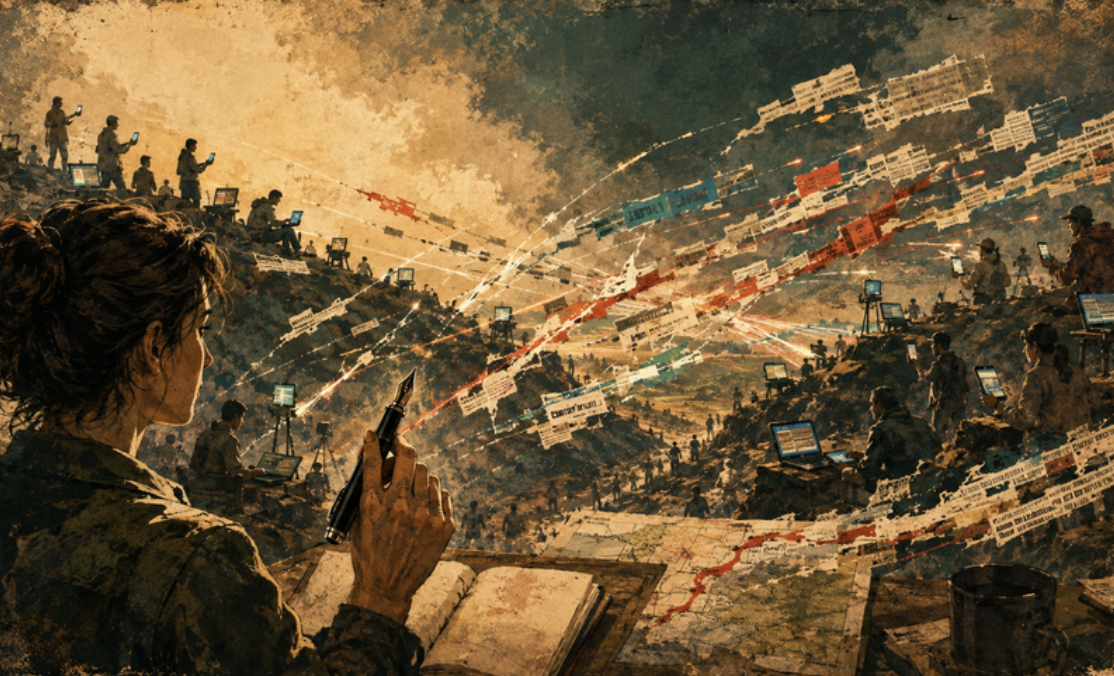
With conflicts in West Asia, Ukraine, Sudan, and elsewhere showing no signs of abating, media focus, rightly, on the kinetic exchanges and their immediate victims. Who is firing what in whose general direction? What damage is caused to military assets, to civilian infrastructure, and to the civilians themselves? Truth, in the fog of war, is always the first casualty. Doubly so in the age of social media and AI. On the information battlefield, smaller belligerents are starting to have equal firing power.
Military technology has undergone a step change in recent years. Drones are all the rage, literally. From large loitering observational platforms to cheap consumer-grade FPV drones. Tiny quadcopters offer the operator a first-person view and the eerie ability to follow their unfortunate targets hiding behind walls, inside buildings, or briefly emerging from an armoured personnel carrier. Historically, technological leaps have tended to shift the military advantage from the defender to the attacker or vice versa. The jury is still out where drones fall on this spectrum. What’s already abundantly clear: you don’t want to be the one who doesn’t have them.
The weapons for fighting information wars have made similar leaps. On its own, social media represented a radical shift. Its global reach and low cost made it much easier for smaller states, non-state actors, or even individuals to produce and spread propaganda (or ‘disinformation’ if it’s your enemy doing it). One can view this as a clear negative, like unfettered access to nuclear or biological weapons. On the flipside, impecunious Robin Hoods are now at liberty to pierce hitherto unassailable ideological bulwarks of unjust dominant powers.
Journalism itself has fragmented. This too is neither as dramatic, nor necessarily as bad, as it sounds. Sure, large Western media conglomerates have been more permitting of dissenting views than, say, the Central Publicity Department of the Chinese Communist Party, but they clearly have biases. In global information markets, these biases are more exposed than ever. And with exposure comes the potential for reform. Put differently, the waning reach of CNN or the BBC, Rupert Murdoch or Axel Springer-owned propaganda factories is filled by nimbler investigative outlets like The Intercept, Zeteo, Drop Site News, Mediapart, Correctiv, Forensic Architecture, which owe their reach to social media.
Okay, back to our military technology metaphor. The cannon rendered medieval city walls obsolete. Aircraft carriers outclassed battleships with superior reach. And where social media had started picking away at centralized information distribution, AI has put this process on steroids. Anyone with a free ChatGPT account and an axe to grind can broadcast. It’s a bad time for gatekeepers.
The empires strike back
Western authorities have not been able to reverse the fundamental power shift. The US threatened to ban, then forced the sale of China-based TikTok for spreading information deemed insufficiently aligned with Western interests. Age requirements for social media are now in place in Australia. Other countries are considering similar moves. Platforms and users adapt around rules, and the overall information environment remains far more contested and less hierarchical than that of the pre-social-media era.
Authoritarian regimes seem to have achieved tighter domestic containment. China continues to suppress most open dissent, shaping the information environment with high effectiveness, while Russia has largely shut out major Western platforms, and mandates registration of bloggers with more than 10k followers. But for how long? Local Chinese AI models already enable citizens to “vibecode” censorship-skirting tools, albeit at a limited scale. Next-generation tools running on ever cheaper hardware can be expected to lower the skill threshold further.
Zooming out
AI’s potential doesn’t seem to stop at ‘merely’ renegotiating human power relations. The same forces that have equalized information firepower are beginning to put pressure on slower, institutionalized knowledge systems: the scientific and philosophical frameworks that have long organized our understanding of the world. Inside societies, democratic or otherwise, the establishment of common knowledge frameworks has historically been a glacial process. Consensus views are established over years, decades, and indeed centuries. The longer any paradigm holds, the more difficult it becomes to dislodge it, however erroneous. Ask Galileo Galilei.
A looser, faster exchange of ideas is not necessarily a bad thing, but challenges abound. Mathematicians using AI are solving one age-old maths problem after another. Over time this is likely to revolutionize our very understanding of the cosmos, particularly in those domains where the bottlenecks have mainly been mathematical rather than purely observational. What happens at the boundary of a black hole? What, if anything, preceded the Big Bang? These are not isolated curiosities; the same AI-driven acceleration is beginning to affect other long-standing bottlenecks — mathematical, conceptual, and engineering — that shape how we understand both mind and matter. Follow me a little deeper into the rabbit hole.
Thinking about thinking
Current materialist theorists see consciousness as a deterministic process, with the ‘self’ arising out of sufficiently complex arrangements of molecules. If this is indeed the case, a warehouse stacked to the roof with Nvidia chips should produce the same end result as a wet brain, i.e. consciousness. Some wonder whether our frontal lobes should more accurately be seen not as a transmitter of thoughts, but as a radio receiver, filtering specific frequencies of an all-enveloping higher-dimensional universal consciousness field. This used to be fodder for philosophers, but one of the results of the arms race to build ever bigger models is set to take the first option off the table for good.
In the realm of more practical pursuits, like the number of lightbulbs humans can screw in without destroying the habitats of monkeys and all the rest, we are already seeing timelines for commercial-scale nuclear fusion energy — the stuff that runs the sun — being compressed by AI-powered maths. AI will destroy us? Perhaps it will save us first.
Language
With power structures and even the foundational frameworks of knowledge shifting underneath us, what remains? What can we be sure of anymore in this fluid age? Short of reverting to a Descartes-inspired hard philosophical reset, a sensible, albeit makeshift, answer would be to focus on the glue that has held together the human family since the beginning of language itself: stories. At the most basic level, what has anchored groups of people is language itself, from when we could barely rub two sticks together all the way down to the age of self-driving cars. Without communication, no fire, no spears, no Zoom calls, no survival. A bit of a stretch, the Zoom calls, but you get the gist.
But however smart, technology will never tell us where to go. No device can connect past, present, and future quite like the retold overcoming of obstacles on our way to the next watering hole. Stories provide meaning. They connect disparate moments that exist in a static three-dimensional cube into a four-dimensional connected string with an arrow in the shape of the word ‘Why?’. Humans have often, prosaically, wondered what sets us apart from animals. Perhaps it’s the same thing that distinguishes us from intelligent machines, namely the ability to formulate purpose and direction. And to attack each other by undermining the other group’s ability to do so.
Information integrity
As battlefields go, the defence of reliable information with which individuals and societies articulate goals and steer decision-making can hardly be overestimated. Empirically speaking, facts are relatively easy to prove or disprove. But motivation, direction, meaning, or the lack thereof, are harder to salvage when under attack. Foreign Information Manipulation and Interference (FIMI) by malevolent actors is not only used to spread one side’s version of events. Increasingly sophisticated technological means, including AI, are directed at societies’ ability to process information, or even to exist as a group. Propaganda is not a new thing, but the speed, scale, and low cost of advanced forms of cognitive warfare are.
Not all heroes wear CAPS
And so, arguably, guarding the thin red line between chaos and civilization are a quiet bunch. More or less the opposite of the hard-nosed colonel portrayed by Jack Nicholson in A Few Good Men, famously blurting: “You can’t handle the truth.” Communication professionals beaver away discreetly, strictly lower case. In defence of truth, connecting decision-makers with everyone else. From the tiniest NGO, to countries, supranational associations, and humankind itself, answering the ‘Why?’ question is the hardest and also the most crucial. Without it, empires flounder, continuously winning battles but losing the plot.
Soon, anyone with a Claude account will be able to produce a two-minute explainer video. Good. The tooling was never the interesting part. What a model cannot do is decide what the video is for: which single idea, out of forty competing ones, survives the edit; what the audience already believes and where that belief will resist; what tone earns a donor’s trust and which faux pas loses a field office. Techniques get cheaper; direction gets scarcer. The further the craft floor drops, the more the challenge migrates upward, to the person conceiving the brief and answering for the choices in it: the comms strategist. We can allow the STEM field that produced this technical marvel its well-deserved victory lap. But perhaps it's time for us lowly humanities folks to come galloping back onto the battlefield and brandish our… pen. Which, as it turns out, truly always was mightier than the sword.
Author’s note: The text is fully human-written. AI helped map the research, stress-test the argument and proofread spelling and grammar. The analysis, voice and final wording are mine, as is responsibility for any errors.
First published on makeshiftpublishing.com on 27 August 2026